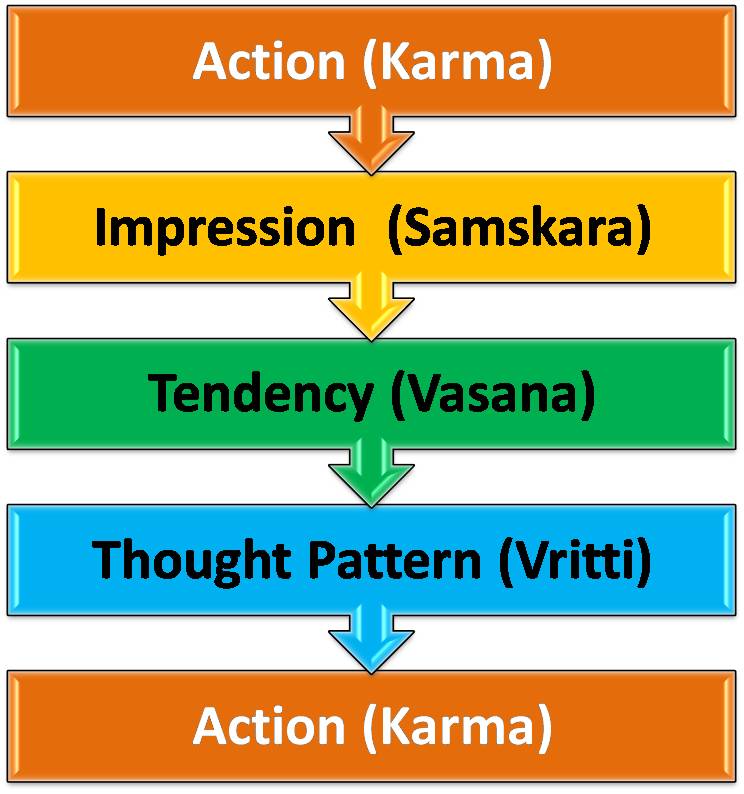
In a previous article, I presented the concept of samskara, the impressions left in our subconscious mind by our thoughts and actions. When certain actions and behaviors are done repeatedly, their samskaras take the form of deep-seated tendencies and desires which are known as Vāsanās. Given an appropriate trigger, these tendencies and desires spring up as memories in the active mind and propel us to do further actions that fulfill the desires.
These concepts are pivotal in understanding the objectives of yoga and how they can be achieved as presented in the Yoga Sutras of Patanjali.
In essence, every vasana is a samskara but every samskara is not a vasana. The difference between the two is subtle. Many a time, we see them used interchangeably.
In this article, we’ll take a closer look at these two concepts and see how they shape our life patterns. We’ll also look at some of the yoga sutras that discuss these concepts.
Saṃskāra
Have you ever wondered why we behave in a certain predetermined way in a given situation? For example if someone cuts you across while driving, your immediate reaction may be to shout and curse at the other person. Or, if someone screams at you using harsh words, you are likely to shout back with even harsher and unpleasant words. These so-called “knee-jerk” reactions are a result of deep-seated impressions that have been left in the deep subconscious levels of the mind. These impressions have accumulated not only during this life but over multiple lifetimes. These deep-seated impressions in the mind are called samskaras.
The Sanskrit word ‘saṁskāra’ (संस्कार) is a composite of two words – sam and kāra. The word kāra is derived from the root kṛ (कृ) which means “to do”. The literal meaning of the word samskara is purification, refinement etc. However, in the context of spirituality, it implies the impressions or subtle imprints that are deposited in our subconscious mind as a result of our thoughts, actions and experiences.
Vāsanā
Vasanas are formed through repeated behaviors and experiences, which create grooves in the mind, much like a river carves its path through land. They represent deep-seated tendencies, propensities and desires. These vasanas are known to exist from the beginningless time and are the root cause of the continuous cycles of birth, death and rebirth.
The word vasana is derived from the root word “vas/वस्” which means to dwell or stay. Vasana can thus be thought of as the dwelling place of the samskaras which have been strengthened through repeated behaviors.
The vasanas function as both memories of the past and blueprints for the future, influencing how we perceive and interact with the world. While some vasanas propel us toward personal growth and spiritual evolution, others bind us in suffering and limitations. Understanding their nature and purpose allows us to bring unconscious patterns into conscious awareness, empowering us to create a more intentional and fulfilling life.
How are saṁskāras formed?
All our actions are initiated by our desires prompted by our likes and dislikes (called rāga and dvesha). Of course, our likes and dislikes stem from our strong ego (ahaṃkāra or asmitā). It is the ego that ends up dominating the intellect and makes us do undesirable actions which, even though may give momentary gratification, finally result in suffering. All our actions – good/bad or virtuous/non-virtuous – get deposited in our memory as samskara.
Positive and negative saṁskāras
Every experience that we have in life gets stored in our memory bank. Each experience also gets labeled as – I like/dislike it; I love/hate it; I want/don’t want it; It is pleasant/unpleasant etc. When we have a pleasurable experience, it leaves an impression in the mind along with a desire for a repeat of that experience. When a similar desire comes up, we repeat that experience. With every such repetition, the impression in the mind gets stronger and stronger and is known as vasana. As a result of this repeated experience, one may develop a craving for the same experience to happen on a repeated basis. When the need to consume some item becomes totally compulsive, we call that an addiction.
When we have an unpleasant experience, it leaves a negative impression in the mind along with a desire to avoid similar experience in the future. When we have another experience which is “seemingly” similar to that unpleasant experience, but may be totally unconnected, we still want to habitually avoid that experience.
When actions and thoughts are repeated, these samskaras become deeper. The collection of samskaras creates our individual personality and character and also strongly influences our subsequent thoughts and actions. If, for example, we get angry easily, the mind is predisposed to react with anger rather than with patience or understanding. Over time, these samskaras become so strong that it becomes extremely difficult to weaken or erase them. Changing a deeply ingrained mental habit becomes an uphill battle.
In general, positive samskaras lead to constructive habits, virtuous deeds, and instill a sense of inner peace. Good samskaras help us stay aligned with ethical living, mindfulness, and spiritual growth. Some examples of helpful behavior patterns resulting from positive samskaras are: offering selfless help to others (called nishkama karma); establishing a consistent yoga practice which includes asana, pranayama, meditation, proper diet etc.; having a sense of gratitude for what and who we are, and many similar positive and uplifting traits of personality.
Negative samskaras, on the other hand, lead to reactive, unhealthy and judgmental behavioral patterns. They cloud our judgment and perpetuate negativity in relationships, health, or emotional well-being. Some examples of negative samskaras are: procrastination, laziness, habitually delaying necessary activities or avoiding responsibility, reacting impulsively to people and situations, self-doubt, unhealthy habits (over-eating, substance abuse, prolonged and unproductive time on social media) focus on failures etc.
Fruits of our actions
As per the karma theory, we reap the fruits of our karma (karma phala) either in this life, or in a subsequent life. If our thoughts and actions predominantly represent kindness, love, and compassion, our character reflects it. Fruits of these very actions will be returned to us in this life or a subsequent life. If our thoughts and actions are full of hatred, anger, or jealousy etc., those thoughts will bear similar negative fruits in the future.
Samskara and vasana in the Yoga Sutras of Patanjali
As mentioned earlier, the concepts of samskara and vasana play a key role in understanding the practice and the goals of yoga. Patanjali does not offer a precise definition or an explanation of these terms. However, they are discussed extensively in the sutras as well as in the commentary by Vyasa. The implicit understanding is that the students who were being addressed by Patanjali knew these terms intimately. Below are a few sutras which are significant in understanding the concepts of samskara and vasana.
Sutra 1.21: Definition and purpose of yoga – “cessation of the fluctuations of the mind is yoga”.
Sutra 1.122: Two means of attaining an arrested state of the mind – practice (abhyasa) and detachment (vairagya).
Sutra 1.163: In the highest state of dispassion, one gains true knowledge of Purusha and there is non-thirst for even the gunas (constituents of nature).
Sutras 1.174 and 1.185: These two sturas describe two stages of the arrested state of the mind termed “samadhi”. In the first stage, called “samprajnata samadhi”, while all fluctuations of the mind have been stopped, only the object used as a focal point remains. In the other state of samadhi known as “asamprajnata samadhi”, defined in sutra 1.18, all content of the mind is eliminated. In this sutra Patanjali adds that a samskara of this state of “nothingness” still remains in the chitta. In his commentary on the sutra, Vyasa states that the means to get to this state of samadhi is the highest level of dispassion defined in sutra 1.16.
Sutra 1.506: In the highest state of “samprajnata samadhi” (samadhi with a content in the mind), the samskaras that are left in the mind are able to suppress all other samskaras previously accumulated.
Sutra 1.517: The highest state of samadhi, known as “seedless” (nirbija) samadhi, is attained when even that samskara is eliminated.
Sutra 2.138: “As long as the root (kleshas) exists, its fruition will be in the form of species (jāti), lifespan (āyu), and life experiences (bhogāḥ).”
In his commentary on this sutra, Vyasa explains that vasanas are those samskaras that come up as memory in the chitta. These are the result of the beginningless collection of karmas (actions and their fruits) caused by various afflictions (kleshas). The topic of kleshas (afflictions) is discussed in sutras 2.3 thru 2.9.
Sutra 4.89: The vasanas are manifested appropriate to the fruition of the three kinds of actions (good, bad, and mixed) defined in sutra 4.7.
Sutra 4.910: Even though separated by species, place and time, there is an uninterrupted flow of vasanas due to the oneness of samskaras and memory.
Even though the concepts of samskara and vasana are discussed in many other sutras, I have presented above some of the key sutras that discuss these concepts.
Summary
These concepts can be summarized in a few simple sentences:
- Every experience creates a perturbation (vritti) in the mind. An experience may involve cognition through any of the five organs of sense perception (smell, touch, taste, sight, hearing), something that we bring up from memory, or some action that we perform through any of the five organs of action (hands, feet, speech, elimination, procreation) etc.
- Every vritti gets recorded in the memory as a samskara. Let’s take the example of drinking wine. When we drink wine for the first time, its smell, taste etc. cause vrittis in the mind. Each of these vrittis creates a samskara in the mind.
- If the experience is pleasurable, we repeat the same experience multiple times and the samskaras created get stronger. After some time, the very thought or sight of wine creates the desire to have it again. This desire is created by the samskara which is now given the term “vasana”. In essence, a samskara which brings up the vritti of memory involving a desire or an inclination is called a vasana.
- A vasana is thus seen to create an action called karma. A karma can be labeled as “good” karma (punya) or a “bad” karma (apunya). Every karma will bring about its fruition either in this life or a future life.
- Thus the cycle of vasana that creates a desire in the form of a vritti which results in some action, the vritti causing a new samskara etc. continues.
- According to the theory of karma, when the physical body dies, the subtle body which includes all the memory of vasanas etc. is carried over to a new physical body to continue the cycle of birth, death and rebirth. This cycle continues until one attains liberation by realizing the separation between Purusha (the soul or atma) and Prakriti.
Concluding Remarks
An understanding of the concepts of samskaras and vasana empowers us to take charge of our inner landscape. These mental impressions, whether positive or negative, shape our lives and influence the way we perceive and interact with the world. By becoming aware of the samskaras that govern our thoughts and actions, we open the door to inner transformation. Through consistent practice of self-awareness, self-reflection, and practicing the tools offered by yoga, we can weaken the grip of negative patterns and cultivate uplifting, positive ones. In doing so, we move closer to freedom from conditioned responses, embracing the potential for living a life full of growth, joy, and fulfillment which can ultimately lead us to self-realization. The journey of working with samskaras is not just about changing habits — it is about rediscovering our true essence, untainted by past imprints, and living a life of purpose and clarity.
[Note 1] Sutra 1.2: योगश्चित्तवृत्तिनिरोधः॥२॥ yogaś-citta-vr̥tti-nirodhaḥ ॥2॥
Yoga is the cessation (nirodha) of the modifications (vrittis) of the mind-field (chitta).
[Note 2] Sutra 1.12: अभ्यासवैराग्याभ्यां तन्निरोधः॥१२॥ abhyāsa vairāgyābhyām tannirōdhaḥ ॥12॥
Their (of the mental modifications) cessation is achieved by practice and non-attachment.
[Note 3] Sutra 1.16: तत्परं पुरुषख्यातेर्गुणवैतृष्ण्यम्॥१६॥ tatparaṁ puruṣa-khyāteḥ guṇa-vaitr̥ṣṇyam ॥16॥
The state of supreme dispassion (higher than the one described earlier) is attained when discernment of the Self (purusha) leads to cessation of all craving caused by the three gunas. (1.16)
[Note 4] Sutra 1.17: वितर्कविचारानन्दास्मितारूपानुगमात् संप्रज्ञातः॥१७॥ vitarka-vicāra-ānanda-asmitā-rūpa-anugamāt-saṁprajñātaḥ ॥17॥
saṁprajñātaḥ (with cognition) samādhi is that which is accompanied by gross awareness, subtle awareness, bliss and a sense of pure being – sutra 1.17
[Note 5] Sutra 1.18: विरामप्रत्ययाभ्यासपूर्वः संस्कारशेषोऽन्यः॥१८॥
virāma-pratyaya-abhyāsa-pūrvaḥ saṁskāra-śeṣo-‘nyaḥ ॥18॥
The other samadhi (asaṁprajñātaḥ, one without an object of awareness) is attained through constant practice of keeping the mind free of all content (virāma-pratyaya) leaving only impressions (saṁskāra) in the mind. (1.18).
[Note 6] Sutra 1.50: तज्जः संस्कारोऽन्यसंस्कारप्रतिबन्धी॥५०॥ tajjas-saṁskāro-‘nya-saṁskāra pratibandhī ॥50॥
The impression produced by this truth-bearing knowledge (prajñā) inhibits all other impressions. – sutra 1.50
[Note 7] Sutra 1.51: तस्यापि निरोधे सर्वनिरोधान्निर्बीजः समाधिः॥५१॥ tasyāpi nirodhe sarva-nirodhān-nirbījaḥ samādhiḥ ॥51॥
When even this impression (created by prajna) is wiped out, every impression is totally made ineffective and there is nirbīja [seedless] samādhi. –sutra 1.51
[Note 8] Sutra 2.13: सति मूले तद्विपाको जात्यायुर्भोगाः॥१३॥ sati mūle tad-vipāko jāty-āyur-bhogāḥ ॥13॥
As long as the root (kleshas) exists, its fruition will be in the form of species (jāti), lifespan (āyu), and life experiences (bhogāḥ). Sutra 2.13
[Note 9] Sutra 4.8: ततस्तद्विपाकानुगुणानामेवाभिव्यक्तिर्वासनानाम्॥८॥ tataḥ tad-vipāka-anugṇānām-eva-abhivyaktiḥ vāsanānām ॥8॥
The vasanas are manifested appropriate to the fruition of the three kinds of actions (good, bad, and mixed) defined in sutra 4.7.
[Note 10] Sutra 4.9: जातिदेशकालव्यवहितानामप्यानन्तर्यं स्मृतिसंस्कारयोरेकरूपत्वात्॥९॥ jāti deśa kāla vyavahitānām-apy-āntaryāṁ smr̥ti-saṁskārayoḥ ekarūpatvāt ॥9॥
Even though separated by species, place, and time, there is an uninterrupted flow of vasanas due to the oneness of samskaras and memory.
Recent Comments