|
|
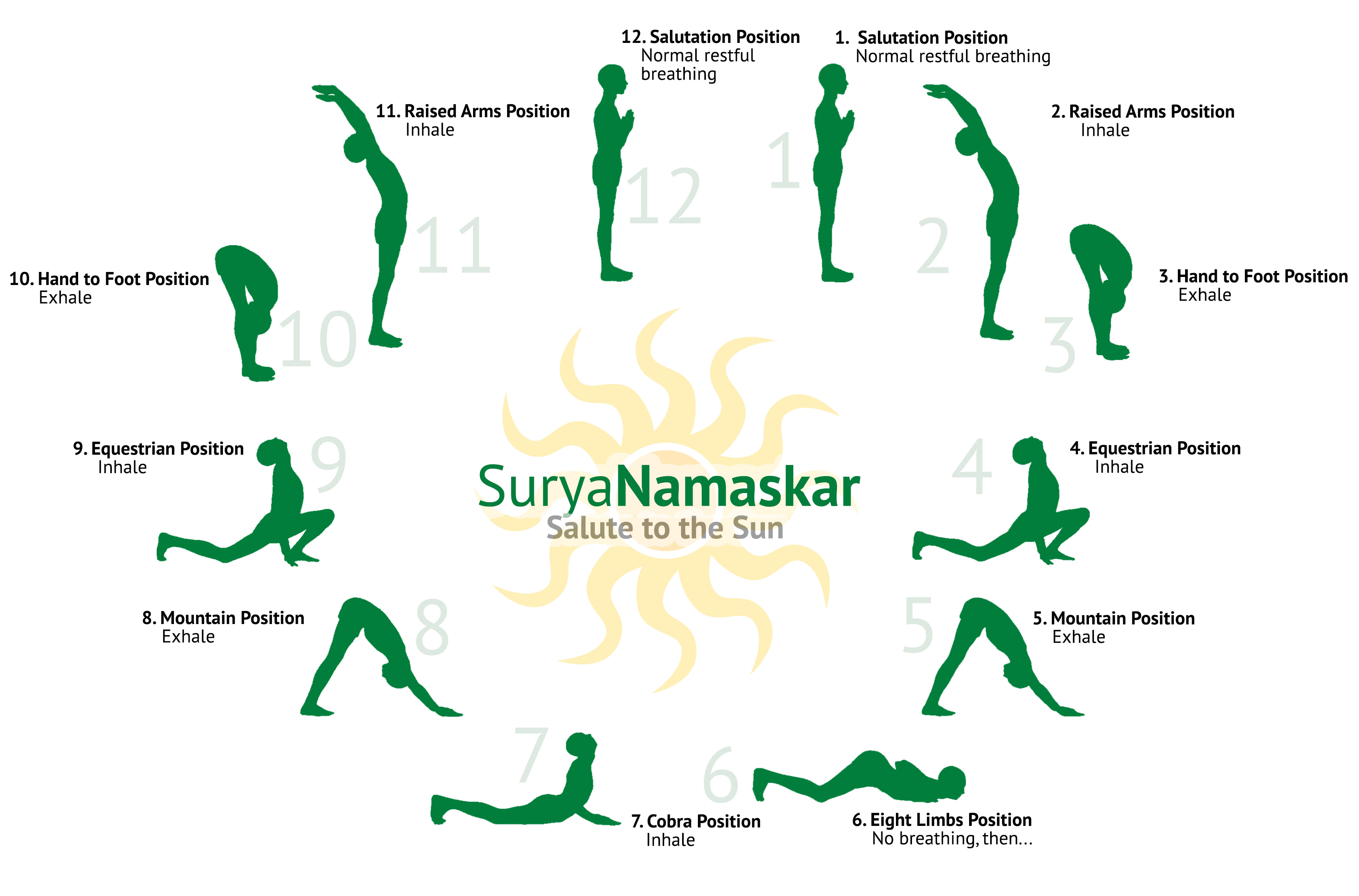
Surya Namaskar sequence
Surya Namaskar (Sun Salutation), in some form or another, is an integral part of most styles of yoga that are practiced today. Integral Yoga (the style that I practice and teach), Shivananda, Kripalu, Power yoga, Vinyasa, Flow yoga, hot yoga … to name just a few of the more commonly practiced styles today – all include some variation of Surya Namaskar as a part of their yoga routine. As we know, most yoga practices have their origins in the ancient yoga texts related to the philosophy and practice of yoga. The two most commonly referenced texts for the practice of Hatha Yoga are the Hatha Yoga Pradipika and the Gheranda Samhita. However, when you look at these two texts, you will find that no mention has been made of the practice of Surya Namaskar. So the question that comes to mind is "how come Surya Namaskar is such a common component of all Hatha Yoga practices today when it not even mentioned in any of the ancient yoga texts?".
Continue reading »
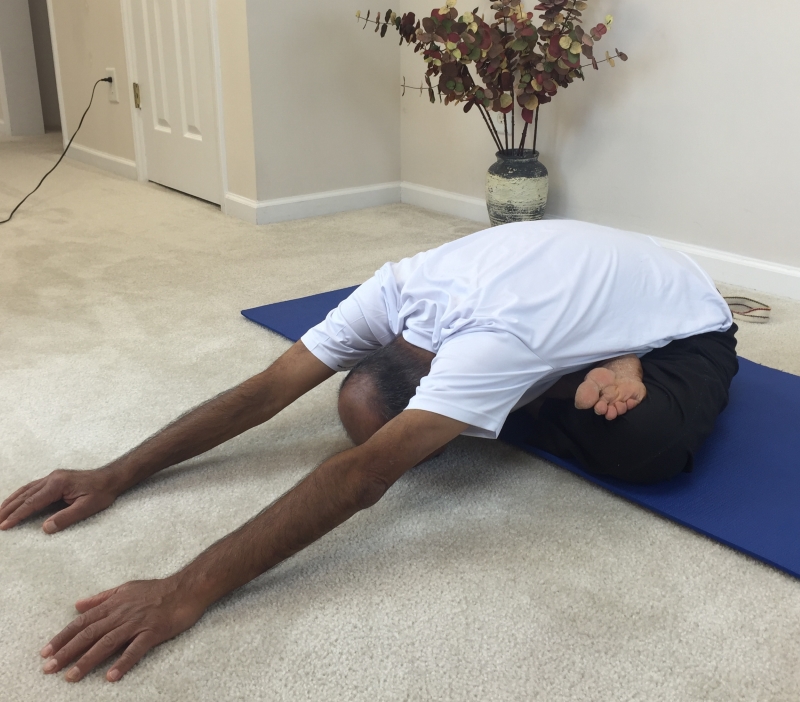
Agni Stambhasana (Firelog pose)
If you haven’t tried the pose before and you look at a picture of the pose, the Agni-stambhasana [audio:http://www.integralyogastudio.com/sounds/agni-stambha.mp3] may seem deceptively simple. However, if you have tightness in the hips, knees or the ankles, this pose can become quite challenging. The word agni-stambha (अग्नि-स्तम्भ) is a composite of two Sanskrit words – Agni means fire and stambha can mean a pillar, a support or just a log. So this name is usually translated as the fire-log pose. In the final position, the position of legs in the pose gives the impression of a couple of fire logs stacked one on top of the other. When you practice the pose, it may actually give you a burning sensation in your hips or knees.
Continue reading »
How often should I practice yoga?
The simple answer is – Every Day! Yes, to get the full benefit of your yoga practice, it is important to establish an ongoing daily practice. Remember the definition of "practice (abhyasa)" as per Patanjali in his Yoga Sutras, "Practice becomes firmly grounded when well attended to for a long time, without break and in all earnestness." (Sutra 1.14).
As you know, most of my classes are 1.5 hours in duration. However, for your personal home practice, it is not necessary that you allocate a full 1.5 hour session. Even if you can build a regular practice for, let us say, half an hour each day, it will go a long way in filling your day with energy, vitality and keep your mind calm and focused. Depending upon how much time you can allocate for your yoga practice, I’d be happy to recommend a routine that you can fit into that schedule.
If, however, your work and/or family situation is not conducive to a daily yoga schedule, you may try to practice as often as you can during the week. When you start practicing on a regular basis, you will start seeing the benefits of the practice. This will hopefully motivate you to deepen your practice even further by adding some additional time for the practice.
I am just too busy – how do I find time for yoga?
Continue reading »
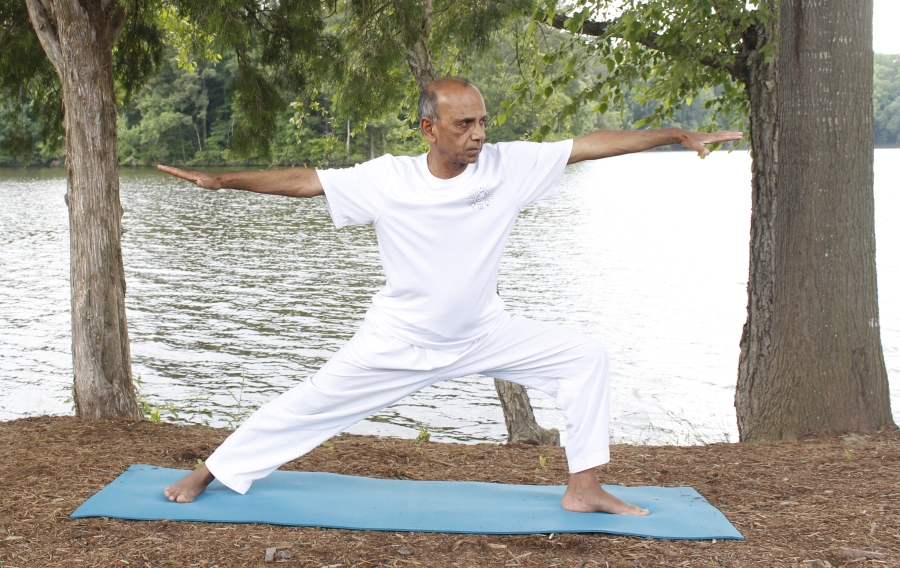 Virabhadrasana (Warrior2)
I am pleased to announce the next 21-day Yoga Challenge program. The past programs have been very well received by all the participants. For most of them, it has been truly a life-transforming experience. I invite you to join me on this exciting and deeply rewarding 21-day yoga journey. Here are the particulars:
[Please download the flier here]
- When: Monday, January 5 – Sunday, January 25, 2015
- Time: 6:00 AM – 7:30 AM
- Where: 4000 Bear Cat Way, Suite 102, Morrisville, NC 27560
- Cost: $125
Continue reading »
(Guest post by freelance contributor Anne Healey)
Chronic pain affects 100 million of us in the United States, which can be debilitating, impacting on everything from your sleep to your employment. While you may leave a visit to your doctor’s office with a prescription for stronger painkillers, if you are keen to explore more natural options for pain relief, research shows that yoga is an effective way to alleviate discomfort. While the benefit of yoga for easing back pain is fairly well-known, you may not realize that it can help with a range of other painful conditions. If you suffer from arthritis, migraines, fibromyalgia, peripheral neuropathy or multiple sclerosis, here we take a look at how making yoga part of your regular routine can ease your discomfort.
Continue reading »
In a previous article, I wrote about the breathing technique called the Ujjayi breath. In this breath, while breathing in and out through the nose, we constrict the passage of air at the base of the throat area, the glottis, which makes a slight hissing, ocean wave like sound. In normal breathing the friction of the air happens at the tip of the nostrils. In Ujjayi, we allow the friction to happen at the glottis area and not in the nostrils. Because of the constriction of the passage of air, the Ujjayi breath allows us to prolong the duration of each breath. Moreover, the gentle hissing sound has a very calming effect on the nerves and the mind.
In another article, I also talked about the deep three part breathing wherein we engage the full capacity of the lungs for each breath. We do this by bringing awareness to the three segments of the lungs – the top, middle and the bottom and consciously breathe into those areas. Thus, at the end of inhalation, the lungs are completely filled to capacity. At the end of exhalation, we allow the lungs to become fully empty of all air.
Continue reading »
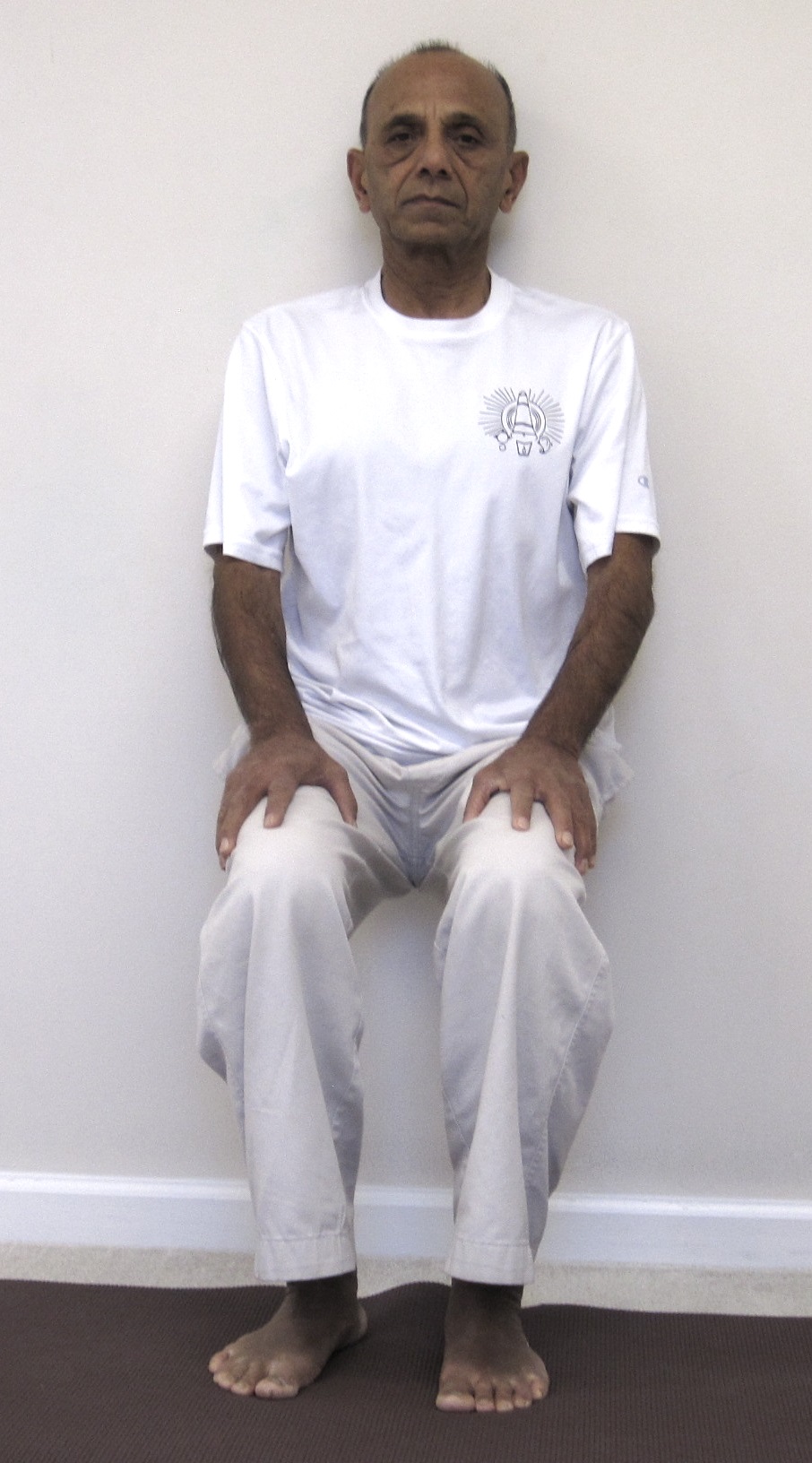 Virtual chair against wall
This post (part 2) is a continuation on the theme of presenting asanas that are very effective in building strength and flexibility in the quads. Please visit the previous post (part 1) for more asanas.
Quads (short for quadriceps) are the group of four muscles in the top part of the thighs. Quads, in combination with the hamstrings (back of the thigh) provide an excellent support structure both for the knees as well as the spine. Strength and flexibility of the quads can usually translate to healthy knees and a strong spinal column.
Most people pay very little attention to the quads. In fact, many of my students realize how tight their quads are only when they try to do a certain yoga pose which involves these muscles.
Continue reading »
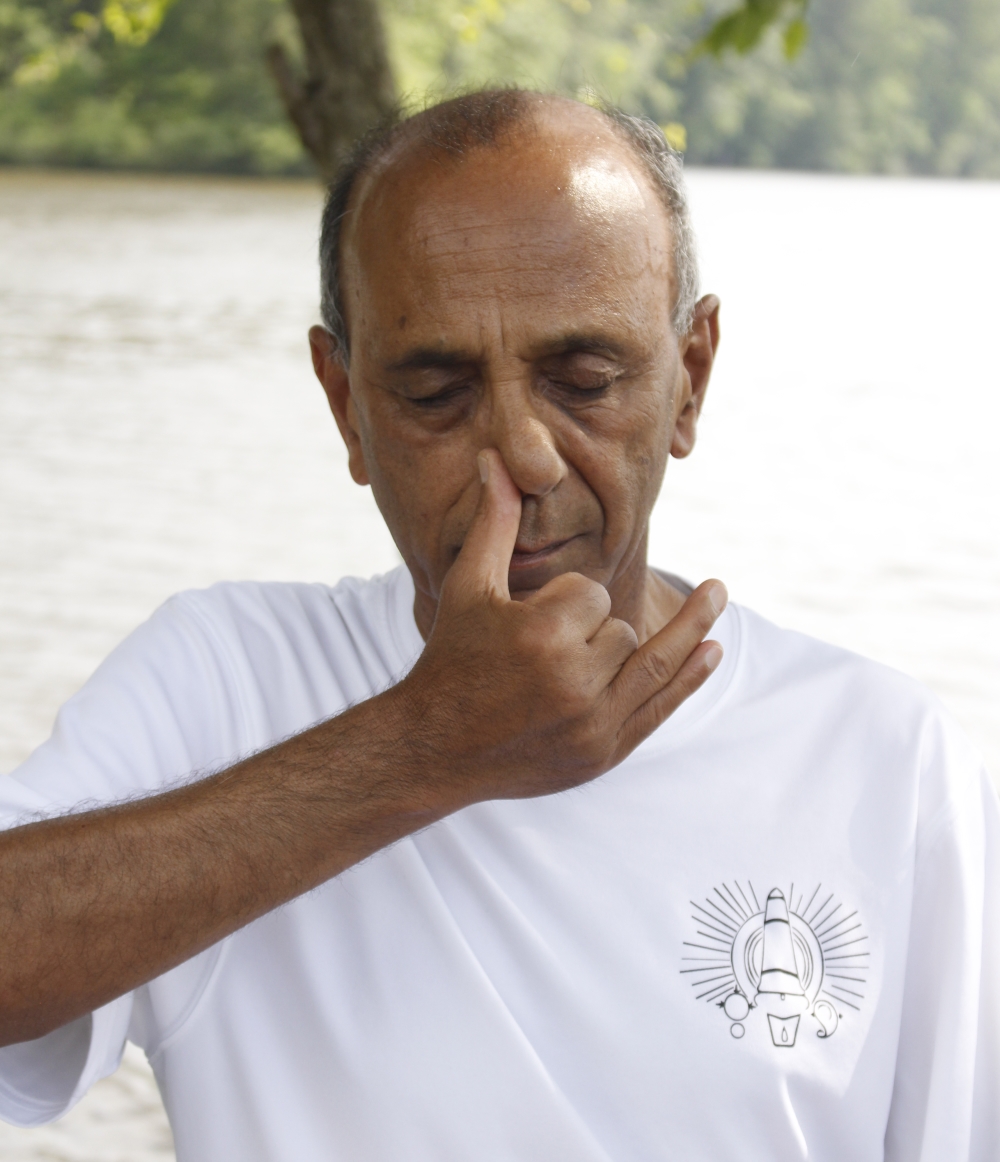 Vishnu Mudra
I am pleased to announce the next 12-day pranayama/meditation intensive.
Come and join me for this life-transforming experience where you will learn two of the most important aspects of a complete, integrated yoga practice – pranayama (breathing techniques) and meditation. In this program you will be introduced to many of the breathing techniques that are mentioned in our ancient yogic texts. You will also learn the concepts and techniques of meditation.
No prior pranayama or meditation experience is required.
- When: Wednesday, December 3- Sunday, December 14, 2014
- Time: 6:00 – 7:30 AM
- Location: 4000 Bearcat Way, Suite 102, Morrisville, NC 27560
- Daily Routine: Light stretching (10-15 minutes), Pranayama (30 min), Relaxation (10 min), Yoga philosophy (15 min), Meditation (20 min).
- Commitment: A firm commitment to follow this schedule and attend every day
- Fee: $75
Continue reading »
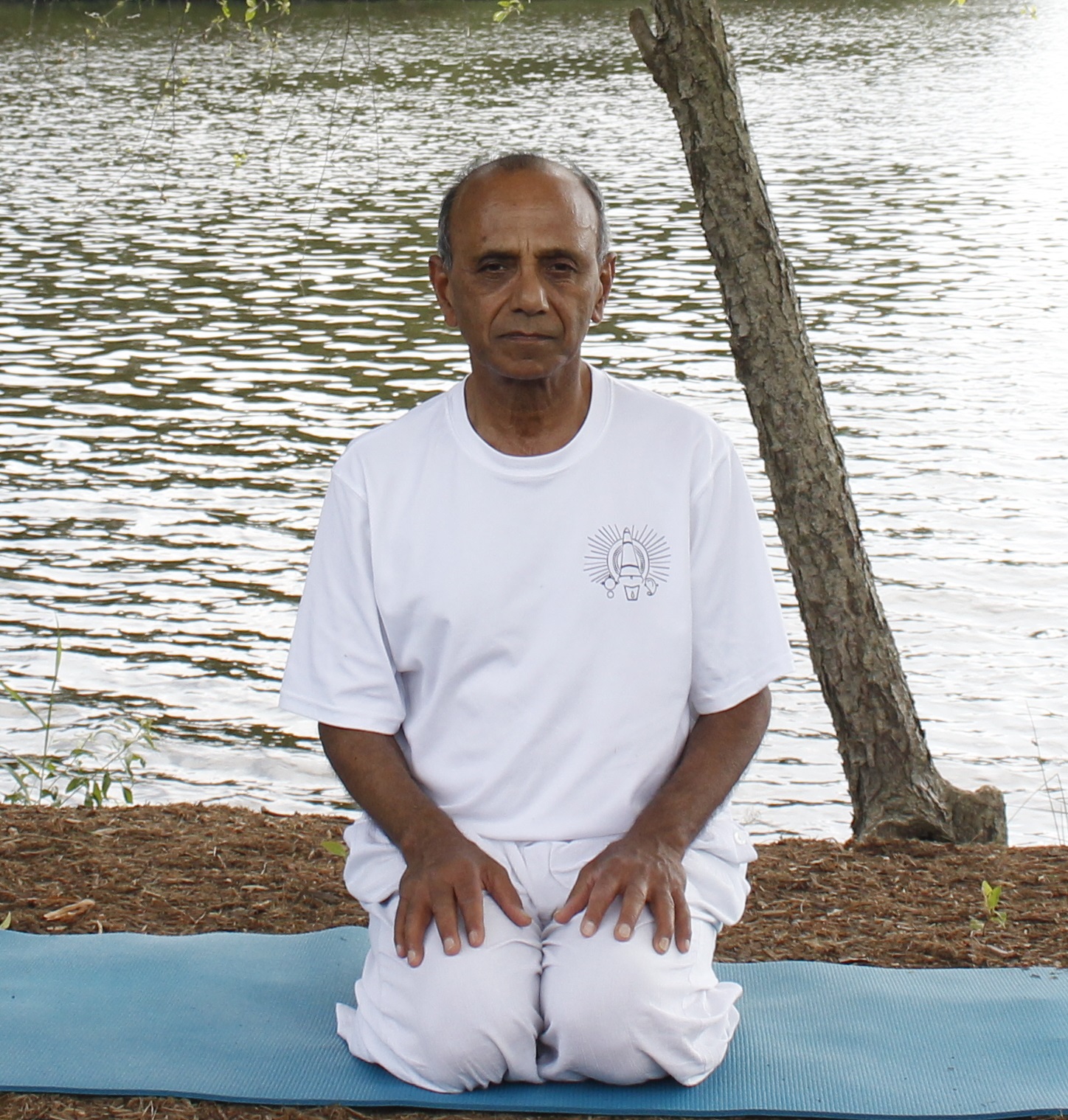 Vajrasana
Quads (short for quadriceps) are the group of four muscles in the top part of the thighs. Quads, in combination with the hamstrings (back of the thigh) provide an excellent support structure both for the knees as well as the spine. Strength and flexibility of the quads can usually translate to healthy knees and a strong spinal column.
Most people pay very little attention to the quads. In fact, many of my students realize how tight their quads are only when they try to do a certain yoga pose which involves these muscles.
In today’s post, I will be presenting a few simple asanas (yoga postures) which will be very helpful in making the quads stronger and more flexible.
Vajrasana (Diamond Pose)
Continue reading »
What is Yoga?
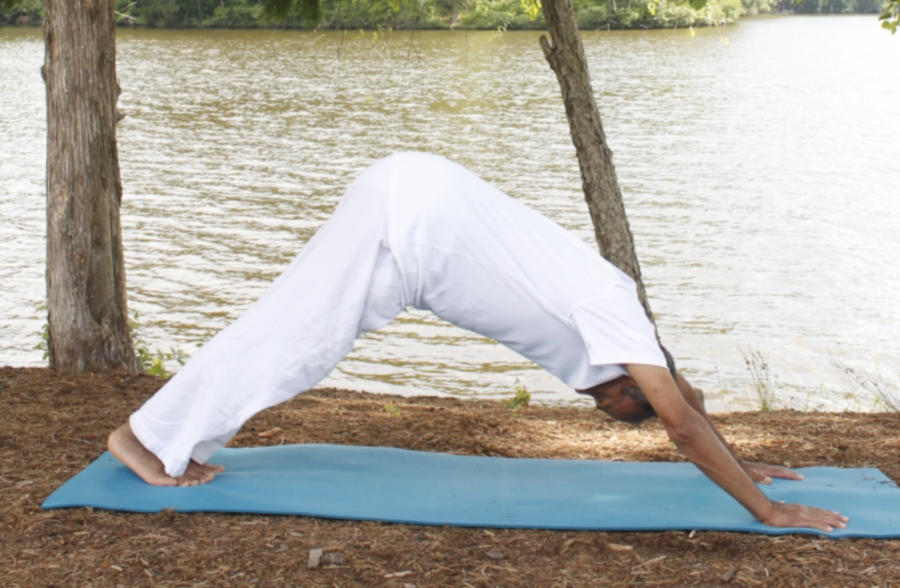 Downward Facing Dog
Starting with today’s post, I will be writing about some of the most common ‘frequently asked questions’ related to yoga from time to time. I will start by answering the most important and the obvious question, "what is yoga?"
If you look up the word "yoga" in the Monier-Williams Sanskrit dictionary you will find close to 40 different meanings listed. Going through this list, you will realize that the meaning depends largely on the context in which it is used. It is fair to assume that the meaning has evolved throughout history.
As an example, in one of the most revered texts, The Bhagavad Gita, the word yoga has been used in the title of each of the eighteen chapters of the book. For example, the first chapter is titled, "Arjuna-vishada Yoga" (Yoga of Arjuna’s despondency). Here the word yoga is used to indicate Arjuna’s state of mind on the battlefield.
Continue reading »
|
Video DVD
Yoga with Subhash (asana and pranayama)
- Basic asana sequence (~50 min) ($18)
- Pranayama/Meditation (~35 min) ($12)
- Set of above two ($25)
Video recording of special programs offered in the past
(Links to YouTube videos will be provided)
- 21-day yoga immersion - $40
- 7-day hip opening intensive - $20
- 14-day meditation intensive - $30
- 14-day pranayama intensive - $30
- 7-day hamstring/quad intensive - $20
- 14-day Level 2 yoga intensive - $35
Payment options:
- cash, check, Zelle (use subhashmittal@gmail.com) or Venmo (use 9199269717)
- PayPal (go to bottom of page) (add $5 to the fee listed above)
Please contact me if you would like to buy.
Recent Posts
-
40-minute Yoga sequence with asana, pranayama and meditation
-
FREE Yoga Class, Jan 1, 2026, 8:00-9:30 AM
-
21-day Yoga Immersion, Jan 5-25, 2026
-
FREE 2-day Pranayama session, Dec 20-21, 2025
-
Saṃskāra and Vāsanā: deep-seated impressions that mold our lives
-
14-day Meditation Intensive, Nov 9-22, 2025
-
Supta (Reclining) Vajrasana
-
Enjoying the journey
|
Recent Comments