In the ancient text on the practice of Yoga, "Hatha Yoga Pradeepika", six cleansing techniques have been prescribed: Neti: nasal cleansing, Dhauti: cleansing of the digestive tract, Nauli: abdominal massage, Basti: colon cleansing, Kapalbhati: purification and vitalization of the frontal lobes, and Trataka: focused gazing.
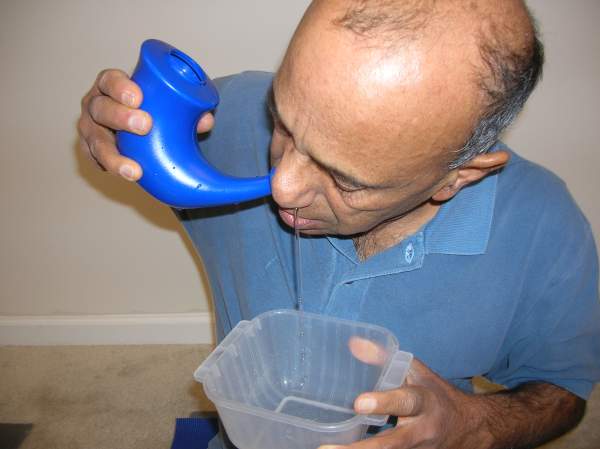
In this discussion, we will be focusing on one of the nasal cleansing techniques called "jala neti" (saline nasal irrigation). Jala Neti is a simple technique which involves using a special "neti pot" filled with warm, slightly salted water. The nose cone is inserted into one nostril and the position of the head and pot is adjusted to allow the water to flow out of the other nostril. Whilst the water is flowing through the nasal passages one breathes through the mouth. After half a pot has flowed in one direction, the water flow is reversed. When the water in the pot is finished, the nose must be properly dried.
To a person who has never used it before, the technique may seem a little intimidating. However, the technique is not hard or uncomfortable. Most people are pleasantly surprised after even their first attempt at just how simple and effective this method of health maintenance is. Once learned, the practice can be done in about 3 minutes, and like showering and cleaning the teeth, Neti is easily integrated into ones daily routine.
For general nasal cleanliness, practicing neti once a day is usually sufficient. In the case of a cold, 2 -3 times a day will give great relief, providing the nose is well dried each time and this frequency does not induce nose bleeds. Reduce this frequency when the worst of the congestion is over.
Jala Neti is best practiced first thing in the morning to clear out the night’s grogginess and prepare the body and mind for the day’s breathing activities. However, if you live or work in a dusty or polluted environment where the nostrils have an increased load of filtering, a good second occasion is upon returning from such work. Neti should always be done before rather than after meals. The best times are: (i) upon waking before breakfast, (ii) mid morning before lunch, (iii) evening before dinner, (iv) just before bed
Benefits
- Neti removes all the dirt and bacteria filled mucus from within the nose.
- It helps to drain the sinus cavities. This in turn, will help to reprogram the body’s natural mechanisms against nasal infections such as hay fever, allergies, sinusitis and other upper respiratory complaints like sore throats and coughs, post nasal drip, inflammation of tonsils and adenoids.
- It is beneficial for illnesses such as asthma and bronchitis as it reduces the tendency for mouth breathing by freeing the nostrils of mucus.
- It has a cooling and soothing effect on the brain by drawing out excessive heat, and is therefore beneficial for headaches, migraine, epilepsy, temper tantrums, hysteria, depression and general mental tension.
- Neti is of great benefit for problems associated with the eyes. It helps flush the tear ducts, encouraging clearer vision and gives a sparkle to the eyes.
- It can be beneficial for certain types of ear disorders such as middle ear infections, glue ear, tinnitus.
- Neti improves sensitivity of the olfactory nerves, helping to restore lost sense of smell, and thereby benefits the relationship with taste and the digestive processes.
- It has subtle effects on the pineal and pituitary glands which control the hormonal system. This has a harmonising effect on emotional behaviour.
- Neti affects the psychic centre known as Ajna Chakra which helps in awakening higher states of meditation.
- It helps to stimulate better powers of visualisation and concentration and gives a feeling of lightness and clarity to the mind.
- Neti is excellent for those trying to give up smoking. Since it reduces the tendency for mouth breathing, Neti re-sensitises the nose to the actual pollution of ingesting smoke, thereby de-programming the brain of the physical and psychological addiction.
Anatomy of Nasal Cleansing
The first line of nasal defense is the set of tiny hairs called "cilia" which should trap larger particles entering the nose. These cilia are usually cleansed by normal breathing and by blowing the nose, but sometimes, due to a gradual build up of dirt, they can become clogged and may require washing out. The whole of the nasal passage from nose tip to throat (and beyond) is covered with a layer of mucus. This mucus is secreted from within the mucous lining, and its function is to trap smaller foreign particles and bacteria. The dirty mucus is normally blown out, snorted and coughed out or swallowed. The sinus passages are an even finer mechanism of filtering which, if infected, secrete a runny mucus to evict the germs. This is generally called sinusitis and can be a short term symptom or a chronic condition.
During the neti practice, the water simply flows up one nostril to just above the bridge of the nose where the usual air flows meet, backwards into the middle cavity and then down and out the other side of the nose. In this route, it passes by the frontal and mid nasal sinuses. The practice does not cause any discomfort or damage to the nasal functions.
The way in which Jala Neti rinses out the dirt and bacteria filled mucous lining would be obvious to most people as the warm water loosens and dissolves any internal build ups, and takes them outwards. But what may not be so obvious is that, due to gravity and a venturi effect, the sinus passages are also drained by the vacuum pressure flow of the water. Whereas it would normally be impossible to drain a "dead end" cavity like the sinuses, Jala Neti achieves this ingeniously and simply.
For those with thick mucus conditions as well as those with running sinuses, the relief of sinus pressure can be felt within seconds. Also, the eustachian tubes (which are also dead end passages) receive exactly the same effects as the sinuses – a drawing outwards of dirt and mucus. Hence Jala Neti is of great benefit for blockages and infections of the middle ear, by draining the tubes to relieve the pressure build up as well as removing germs.
The eyes derive benefit by Neti. The tear ducts, which connect from the eyes into the nasal passages, get the same drawing out effect as the sinuses, resulting in a brighter, clearer sense of vision.
The nose is the "air conditioner" of the body. One of the many functions of the nose is to regulate the temperature and humidity of the incoming air. This is necessary so that the breath does not strike the throat and enter the lungs too hot or too cold, too dry or too wet. Upon exhalation, the nose also helps to draw out excessive heat from the frontal portion of the brain, which is the part where the heavy thinking is done, and where the greatest heat builds up when under stress. People with chronic nasal blockages who end up being habitual mouth breathers, therefore have a cooled throat, which imbalances the thyroid function. They also have cooler lungs, which creates excessive moisture and mucus secretion in that area. Mouth breathers also fail to get enough of the cooling effect from exhalation at the front of the brain, and can therefore be described as "hot heads". Regular practise of Jala Neti helps to establish the correct working environment of temperature and humidity in the nose.
Another aspect of physiology which Jala Neti affects is the relationship between olfactory function and the body’s nervous systems. According to medical science, there are two branches of the Autonomic Nervous System called sympathetic and the parasympathetic which are constantly working to keep in balance. Each of these systems affects different organs and functions of the body. Basically, one controls the functions of stimulation and the other controls the functions of sedation. This dualistic push/pull conflict correlates exactly with what the yoga masters say about the forces of Pingala and Ida, or Ha and Tha.
According to yoga science, by balancing nasal breathing function, better balance of the sympathetic and parasympathetic nervous systems is gained, and hence better balance of the whole body’s nervous function is achieved. So, by cleansing, balancing and manipulating these two complimentary opposite forces, better physical and mental health is maintained. Hence it is one of the known effects of Jala Neti that mental tension and headaches can be relieved, as well as nervous system disorders such as epilepsy, and psycho-emotional imbalances like temper tantrums can be controlled.
Technique
- Nasal cleansing can be performed over a sink, a bowl on a table, in the shower or outside. First fill the Neti Pot with warm water of a temperature suitable for pouring in the nose – neither too hot nor too cold. It is recommended that the water temperature should be same as the temperature of the tears. Pure water is best if available but this is not obligatory.
- Mix in salt to the proportion of one level teaspoon for half a litre of water. This equates to 0.9% – the same as human blood – and is called isotonic or physiological solution. Mix the salt thoroughly. Be sure to fully mix and dissolve the salt, as you don’t want fresh water in the spout or very salty water at the bottom of the pot. Pure sea salt is the recommended salt. However, if that is not available, clean table salt which is used for cooking can be used.
- Place the nose cone into the right nostril, sealing it to the nostril with a slight pressure. Try to point the spout straight up in line with the nasal passage so as not to block off the tip of the nozzle on the inside of the nose. Open your mouth and breathe gently through the mouth. Do not sniff, swallow, laugh, talk or have any movement of air through the nose whilst the water is flowing through.
- Now slowly bend forward from the waist so that the tip of the nose is the lowest point of the head; and then tilt/roll the head to the right, so that the left nostril is now the lowest point of the nose. Tilt slowly so that water doesn’t run out the top of the pot onto your face! Keep the nose cone fully sealed into the right nostril so that water doesn’t leak out. Keep on mouth breathing whiles the water comes through. Just wait a few seconds and the water should run out the left nostril. Keep breathing slowly and gently through the mouth. After the water begins to flow, wait for about half a pot to flow right to left, and then remove the pot and stand up.
- Before changing sides, blow out gently through both nostrils to clear water and mucus from the nose. It is important that you do not blow hard at this point or you will send water up into the ear tubes and sinuses. All that is needed is a couple of slow, soft blows out into the sink to remove the water in the nose. Do not pinch the nostrils to create extra force, or blow hard and vigorously.
- Repeat steps 3 & 4 as above, but with the nose cone entering from the left nostril and the flow of water going left to right. After the pot runs dry, stand up, blow out gently through both nostrils and then prepare to dry out the nose.
- Drying the nose properly is a very important part of the practice. First bend forwards from the waist and hang the head down with the nose pointing towards the floor, letting any residual water drain from the nose for 10 – 20 seconds. Then point the nose towards the knees. Closing one nostril at a time, gently breathe in the mouth and out the nose about 10 times. Then stand up to do some rapid breathing through the nostrils. First do 10 breaths through both nostrils together, sniffing in and out moderately with a bit more emphasis on the exhalation. Then close off the right nostril with one finger and do 10 rapid sniffing breaths through the left nostril only. Then do 10 sniffing breaths through the right nostril only. Finally, do 10 breaths again through both nostrils together.
- Another effective technique of draining out any residual water from the nose is to practice a few rounds of the cat-and-cow pose. Failure to dry the nose properly may manifest the symptoms of a cold for several hours, or leaving dirty water in the sinus passages or Eustachian tubes may result in infection.
Limitations and Precautions
Persons who suffer from chronic bleeding of the nose should not do neti without expert advice.
Make sure that the water is not too hot or too cold when you introduce it into the nostrils. Do not breathe in and out too deeply when removing the moisture from the nose; we are trying to improve the condition of your nose, not damage it. Also, when your sinuses are blocked with mucus, be careful not to blow your nose hard. It is very easy to push the mucus further into the cavities. Ensure that the salt fully dissolves in the water before pouring it into your nose.
Be careful to hold the head correctly and not to hold the neti pot too low. In order for the water to flow into one nostril and out the other, the water level in the pot must be higher than the region at the back of the nose, where the two nostrils merge with each other. If you tilt your head too much then the water will go down your throat instead of the other nostril. If you tilt the pot too much the water will merely overflow out of the pot. You must adjust the position of your head and the pot so that they are at correct levels.
People who have great difficulty passing water through the nose may have some structural blockage. Expert advice should be sought. If there is a slight burning sensation in the nose during your first attempt with salt water, don’t worry. This will disappear as your nose tissue becomes accustomed to contact with water.
Can I take jala neti in monsoon season, or when the sun is behind the clouds?
I haven’t seen any such restriction mentioned in any of the texts that I have read. My suggestion – go ahead and do it without worrying about sun or clouds.
Thank you sir for the detailed instructions about drying up the nose after the neti. Not found elsewhere. Very helpful. Am going to bookmark it.
I see that you recommended steam before neti to clear blocked/stuffed nose. My question.. can we inhale steam “after” neti as an “additional” step to dry the nose?
Hello Syam, I am not sure how inhaling steam can dry the nose after neti. Give it a try and see how it works.
Dear Subash, your article has been my reference for some time now for Jal Neti.I learnt the technique very long time ago and have been practicing on and off. Last two years my practice of Jal Neti is more regular and has been helpful as I live in a polluted city. When my nasal allergies disappeared, the practice took a back seat for a few months and I have started again now. However now I see that my nose runs more after Jal Neti and sometimes becomes stuffed after that. I don’t feel the same relief I used to feel earlier. I simply cannot figure out what’s going on. As far as I know, nothing has changed. I use warm water, 1 TSP of rock salt for 500 ml of water. I did move houses and hence the source of water is different; although I have always used boiled and cooled water. What could I be doing wrong?
Hello Maggie, I am not sure what could be causing the reaction that you are having after jala neti. I suggest cleansing out all traces of water from the nostrils by doing a few rounds of cat & cow pose and a combination of up/down dogs right after jala neti. Hopefully things will settle down after a few days of practice. Keep us updated. Thanks.
Hello Subhashji
Really nice article on Jalneti. I am suffering from last 5yrs from runny nose with white mucus (not sure if I can call it cold)
It look like due to changing weather/temperature I get runny nose (white mucus) almost everyday specially morning time. Sometimes if I get up in the middle of night to have water or to use restroom then I will get runny nose and it will not allow me to sleep further. I have tried allergy medication but those help temporarily.
Is it a good idea to do Jalneti when we have runny nose with white mucus ? And will it help in this condition ?
Thanks
Prafull
Hi Prafull, yes, you should definitely give jala neti a try. If the nostrils are clogged, you may want to inhale steam for a couple of minutes before trying the neti. Steam will help you clear your nostrils. There is a good chance that Jala neti will help your situation with runny nose.
Thanks Subhas for your reply, I will try it
I am presently suffering from sinusitis. Allopathy doctor has advised me to take steam and have prescribed medicine also. I request you to please advise whether I can do Jal neti in the morning and can do steam inhalation at night before sleeping.
Thanks
Rajinder Singh
Sure, Rajinder, it is OK to do the jala neti in the morning and steam in the evening. If, on a given day, the nose is clogged for jala neti, it will be helpful to do the steam inhalation just before jala neti so the nasal passage can get cleared for neti.
Did taking steam worked for you… To get water flowing from other nostril too.
Mine is similar case, water does not come out at all.
It depends upon the intensity of blockage in the nostrils. With mild blockage, steam works fine – not when it is severely blocked.
few articles mentions that jal neti should not be performed when one is suffering from cold. but in this article it is mentioned that it can be used to cure cold, sometimes chronic colds also. now i m very confused, what are the cases where we should not perform jal neti??
Hello Ankur, could you please provide reference to the articles that you are referring to? I would definitely like to know if they are from a reliable source. Here is an excerpt from the book by Bihar School of Yoga, which is one of the most trusted sources for yoga practices, ” Neti is the best method of preventing and eliminating colds. An effective cure for the common cold has not yet been found. Neti is not foolproof, but it goes a long way to solving the problem. A cold indicates something significant, namely that your body is in a weakened condition. If this was not the case, the cold virus would be unable to penetrate the def ences of your system; your autotherapeutic powers would be strong enough to withstand such an attack. The cold virus flourishes in nerve tissue, particularly the olfactory nerves in the nose.During a cold, neti greatly helps by removing the accumulated mucus in the nose, this being a breeding ground.”
If you have a cold and your nostrils are blocked, you may inhale steam before trying jala neti. This should clear your nasal passage.
Thanxx alot sir for your useful information. I have read those articles few weeks ago, cant find the link now, but I have one youtube link (https://www.youtube.com/watch?v=eedrZUApbhw) where it is told that during cold and cough jal neti should be avoided. Actually I am suffering from cold and cough for quite a long period. It is effecting my sense of smell also. Someone told me to see jal neti for curing cold.
Hello Ankur, it depends upon whether your nose is completely blocked due to cold or not. If it is blocked, you cannot practice jala neti. However, you can try to inhale steam for a few minutes before trying neti. steam inhalation is more than likely to open your nostrils. Then it becomes possible and easy to do neti. Try it out!
All the best.
Dear Subhash ji,
I am a regular practitioner of Jala neti whenever I get cold and other nasal related problems.Right now I am doing it to control snoring.I will have to wait and see.Mainly I checked this site to find out whether I can do it in the evening also. I think I got my answer.Yes I can do it in the evening also on empty stomach.Thanks.
Wishing you the best with your neti practice.
Jal Neeti is a Kriya in yogic system whereas Nasya is one of the panchakarmas of Ayurveda. The two of them should be mixed with each other, both are entirely different and have their own benefits.
Dear Subhash, Very good and detailed write-up that gave me the confidence to start the Neto practice after a gap of 25 years. I have been a regular Yoga – Asana, Pranayama and Meditation practitioner for many years now. Needed to get Neti in the mix as my nasal allergies just didn’t go away with Pranayama.
I just wanted to add a couple of tips here that I discovered that might be useful.
One thing I have learnt is that we just need to tilt the head to about 45 degree angle. That seems enough to get the water through the other nostril. Complete 90degree tilt seems to strain the neck as well as increases the chances of water going to the head.
Second, one way to know if the angle of the head and the water pot are correct is that if it all aligns, then there should be no pressure on any part of the head. If there is pressure inside the head, try adjusting.
Keep up the good work, Subash.
Good suggestions, Maggie. Thanks for sharing.
Good morning from Dubai Subhash-ji!
Your Jala neti information was very comprehensive and has enabled me to start effortlessly and practice daily.
I am keen on taking it a step further and allow the water the exit from my mouth. However even now, while doing the nasal jala neti from right nostril, if I reduce my head tilt (raise it), a very minute amount of water automatically exits from my mouth, at times its so little that I have to spit it out.
If I may, I have two questions:
1. I would like to make the mouth jala neti a deliberate practice after I finish the nasal jala neti. Is there a way I can do so by turning my head a particular way, or even look facing up which doing so, to enable the water to exit from the mouth? I’m trying to find a way without sniffing it via nasal to achieve this.
2 Although both my nostrils are generally clear, My left nostril is less clear at all times. Is there a way to cure this to enable me to do the mouth jala neti?
Many thanks for your valuable input and contribution to the yoga community!
Best regards
Bharat
Hello Bharat,
So glad that you found the jala neti information helpful and that you have started practicing it regularly. To get the water out from the mouth, you will need to practice sucking the water consciously through the nose which will bring the water back of the throat so that it can come out of the mouth. It will take some experimentation and practice to get it right. Once you start getting it feels really nice to be able to mix it with the regular practice of bringing water from the other nostril. The imbalance between the two nostrils is quite common and should start getting better through regular practice.
Subhash-ji,
Just to update you, your instructions on bringing the water out through the mouth has worked perfectly for me. I do it as round 2 after finishing Jal Neti. With practice I have found the optimal level of conscious suction of water from the nose while neti water flows.
ONE TIP I’D SHARE WITH MY EXPERIENCE: because breathing in from the mouth ceases while doing this, I first take a deep breath, hold it and then start the process, that way I can suck in the water easily from each nostril without running out of breath. Water effortlessly exits the mouth and I recommend this wonderful practice to anyone.
Thank you and God bless.
Bharat
Excellent suggestion, Bharat, thanks a lot for sharing.
Hello Mr. Subhash
In some Yoga centers I saw they use 2 type of water for nasal irrigation.
First is brown colored water, it contains some herbs. The water is very irritating in nose but cleans all the mucus form the nose.
Second is saline water.
Can you tell the name of those herbs.
Marshal, I am not familiar with the use of colored water for jala neti. You may need to go back to the studio where you saw it and get more info. Share it on this blog as well. Thanks.
I saw on TV ramdev baba was telling Reetha (Sapindus trifoliatus) and Trikatu soaked in water overnight is used for cleansing the nose but he used the term Nasya instead of Jalneti.
I am sure there are more than one techniques for keeping the nose and the associated physiological system healthy. Jalanet is a specific practice that uses salt water for nasal irrigation. I am not familiar with what you have written about Baba Ramdev’s recommendation. You may need to revisit that video to see exactly what he is proposing. If you find out more, please share it here.
Hello Subhash g
Thanks for ur reply
I have noticed that i did not have to take my inhaler from last three days as my breath is fine now.
I wish jal neti keeps working inside me with the same way so i do not have to take inhaler for easy breath. It should become natural.
I will be very happy if jal neti removes my inhaler
I will share my experience about breath and nosal blockage after few days more practice of jal neti
Thank u so much
Regards
Karan
Hello Subhash G
Thank u for ur assistance
One more thing i would like to ask as i have already started it
My one nosetril is always block either left or right so water does not pass when i practice jal neti directly
Then i took steam but it did not work too as steam has not open my block nose so again i was not able to do proper practice of jal neti because water was not passing
Then i tried nosal spray first to open the block nosetril and in a minute it opened my nose an then i again tried jal neti and i was able to do it perfectly so my questions are
1. Can i take nosal spray before jal neti daily ? As jal neti does not work if nosetrils are not opened
2. Do i able to cure my block nose problem/sinus by performing jal neti ?
Please share your views / suggestion in detail on above
As i have read above other comments many more people are facing the same problems
Regards
Karan Singh
Hi Karan,
Yes, if the nasal spray helps, you may want to continue with it. Every now and then try steam inhalation as well. Once it starts working it provides other benefits as well – clearing chest congestion and irrigating the lungs.
Hello Subhash ji
Nice article
I m suffering fro asthma facing breathing problems. I have to take inhaler to breath normally. I am afraid as i am 30 yrs old only and i have to spend my whole life on in halers.
Can i cure asthma or breath problems by doing jal neti regular practice
Looking to hear from u soon
Regards
Karan
Hello Karan,
First of all there is no way to guarantee that jala neti can cure you of your problem. As you may have noticed, I always encourage people to develop a complete practice of yoga including asana, pranayama and meditation. Once you have an established practice, then you can add on the practice of jala neti for added benefits. All this will help; whether it will cure you can only be determined by you after a dedicated practice.
Hi
I am feeling a stiffness in head after neti pot and feel cold sneezing
Please advise
Hi
I felt coolness in my eyes on first day but forehead is a bit stiff.i am feeling cold under fan also.
Hi Prerna,
If you are just beginning with the practice, try not to worry about some of these experiences. If the sneezing etc persists even after practicing for several weeks, then you may want to go to a local yoga teacher to get the practice checked out. that way you will know if you are doing anything wrong.
I am practicing it from last month and having very good result.
Daily perform it in the morning before yoga practice and sandhyavandan or the evening.
My has migraine problem how many time she should perform daily ?
Thanks subhash for details and nice article on jal neti….
Hi Mahendra,
There is no way to tell if and when the migraines can be cured with this practice. you can practice Jala Neti about three to four times a week. In addition, I strongly suggest practicing other aspects of yoga – asana, pranayama, meditation and proper diet control for best results.
sir tahnk u for a good informative article on jalneti
thanks Srinivas, for your kind feedback.
I did the jala neti. Immediately after, my baby started crying and I lay down sideways with him. I felt water go up my sinuses and into my left ear. Still uncomfortable. Should I do something or will it just clear?
Dear Ammu, I think the discomfort in the ear should subside with time. I am aware of anything that you can do to help the situation.
How much time jAL NETI TAKE FOR EFFECTIVE RESULT…..BECAUSE I M HAVING ALLERGY
And i m using medicines after 3_4 days….because of cousg specially at midnight….but i m doing pranayam from the last 10 months….and also started jal neti from the last week
How much time jAL NETI TAKE FOR EFFECTIVE RESULT…..BECAUSE I M HAVING ALLERGY..
Hello Mamta,
It is not possible to predict how long before you see results. The key is to keep practicing – you start feeling benefits slowly.
Hi Subhash ,
I am suffering with nasal polyps past two years. I tried with jalneti and sutra neti. They have disappears many times using these techniques but Now my condition is worst past few months. So I started again to use sutra neti.So tell Sutra neti is good enough to remove huge polyps or I should try something different.I don’t want to go through surgery.Please advise me on this . And more thing Can I use sutra neti and jalneti on daily basis.
Hello Pradeep, I don’t have any experience with nasal polyps. I suggest you continue with both jala and sutra neti – try alternating – one day jala and the next day sutra neti. See how it feels. I wish you all the best.
I am suffering from acute sinusitis for last 4 years. Sometimes I suffer severe nasal blockage, continue for 3-4 weeks.Then some relief. Most of the time I don’t get smell. Last week I started Jalaneti when my blockage was less. My sense of smell improved slightly. How many days per week I should practice Jalaneti to get rid of sinusitis completely. For regular maintenance of nasal cleanliness, I many times per week I should practice Jalaneti.
Thank you
Santanu
Hello Santanu, there is no guarantee that the practice of jala neti will cure you of sinusitis. You should continue the practice since it makes you feel better. I recommend steam inhalation for a few minutes prior to jala neti. This will clear your nostrils and prepare you better for neti. My suggestion is to practice at least twice a week. Try to enjoy the practice and whatever benefits you get. Focusing too much on the outcome can be counter-productive.
Namaste Subhash ji,
About 10 days ago I started Neti (I have tried it in the past but not regularly). It so happened, within 2 days of starting Neti, I developed common cold. I am not linking the 2 but just providing information. I continued to practice Neti daily and it had a wonderful impact of clearing the mucus. All day I felt fine despite the cold. However today I felt that when I bend my head, there is some tension/slight pain in the forehead region. Could it be due to some sinus mucous or can there be some water left over inside. Generally speaking, I think if technique is wrong – I won’t have felt tremendous relief after each practice and I was seeing big amounts of mucous coming out.
thanks.
Hello Shailendra, the pain in your forehead is quite intriguing as it seems unusual, especially after having good results in the past few days. In general, if you have a cold or the nose is blocked, I recommend that you inhale steam for about five minutes and then try the pranayama. Steam inhalation can help clear the passage and make breathing easier and comfortable.
Namaste SUbhashji,
I am fine now – cold (yellowish mucous) is gone but Neti still expels whitish/colorless mucous. It is good I guess. One interesting observation, is that I used to feel while chanting stotrams etc that there is affliction to the voice but after Neti – the voice is clearer and I feel better about the chanting.
thanks and regards
Shailendra
Is it possible that water may enter your lungs if you do Neti incorrectly ?
Dear Ratnesh,
I do not know the answer to your question. Can you let me know what prompted you to ask the question? In my experience of over 20 years, I have not heard of any occurrence of the water going into the lungs.
Hi, Can water enter your lungs while doing NETI (In a wrong manner) ?
I’ve used jalaneti 3 times. I’ve noticed my nose feels different inside which I’m aware of. Is this normal. Thank you
Hi Maria, not sure what you mean by “feels different”. Since you are just starting out you are likely to feel different, and it is normal.
Hi Subhash,
I have been suffering from Nasal polyps for past 9 years. During this period I got nasal surgery done twice. The latest was in 2010, but the polyps has regrown. I have been using corticosteroids for past 1 year and have now completely lost the faith in allopathic treatment. I heard about Jala neti, which can eradicate this problem from root as per my knowledge, but before I start this I have few questions. The polyps in my nose are fully grown, They are so big that I can even see one in my left nostril in the mirror, so will this blockage allow the water to run out from the other nostril if I do Jala neti? My worry is that it should not cause any infection which could later prove hazardous. And I get bad breath also which I believe is due the mucous depositing in the nasal cavity, so will that also be taken care of with the Jala Neti?
Thanks,
Arvind
Dear Arvind,
I am glad that you looking to the practice of Jala Neti to help you with nasal polyps. I do not have any direct experience with this condition. However, I feel that the practice should be safe for you. Try to use only filtered water and clean salt. Whether or not the water will get blocked can only be tested through practice. As you rightly said, Jala Neti will help get rid of excess mucus and any dirt that gets deposited in the nostrils. This should help improve quality of your breath. all the best!
Dear Subhash,
I suffer from severe dry eye and tried Jala neti to see if it would help.
I’ve done it a number of times exactly as you have said but didn’t feel much relief so I decided to try it with very little salt just to see what would happen.
As I was pouring the water through the right nostril, it stung a bit and I felt my right side of my head, inside feel ‘awakened’..I don’t know how else to describe it. Although this was painful, I continued in hope that I may be stimulating something in my brain to solve my ‘dry eye’.
I since have a headache in the right side of my head continually.
Should I be worried? Or do some people perform Jala neti without salt without any dangers?
Hi Saima, I am not sure if the headache is caused by salt. A small amount of salt is supposed to cleanse the entire nasal system. In any case, feel free to try without salt and see if it helps. For dry eyes, you may also want to practice other eye exercises given on my blog here – http://yogawithsubhash.com/2010/01/22/yoga-for-eye-care-a-7-step-program/.
Hi subhash ,it is a very nice post and useful one. The nose drying techniques were so useful.
I have been practicing jal neti for few months.It has given me great relief. I have doubts about the shape of the neti pot. Will that affect my ears or head? Because i have two different neti pots with different shapes, one was good(but it has discomfort with nozzle so i needed new one) and the other one i felt my head slightly pressurized.
Can you share some tips in choosing the right shape for neti pots.
Hello Ambika,
I don’t believe the shape of the pot matters. As long as the spout fits nicely in the nostril, it should be OK.
I have severe rhinitis problem and have been doing jal neti for a while. But while doing so water gets into my head and pains terribly. It however subsides after completion of the process and drying the nose. Am I doing something wrong. ?
Hello Netra,
Normally after practicing the technique for some time one learns how to avoid letting the water go to the head. In general if you tilt the head forward and to the side, and then let the water flow naturally, it should not cause this problem. It is likely that you are trying to push the water through the nostrils in which case it can easily go to the head. Hope it will get better with more practice.
Hello sir,
I’ve been practicing the Jal neti since around a year a now and have gone through tremendous changes in my life and health.
Recently I have graduated to Sutra Neti through a rubber catheter which has really helped me breath deeper. I want to understand from you the frequency of the sutra Neti which should be followed.
Thank!
Hello Ashish,
I believe the frequency guidelines are similar for jala neti and sutra neti. I personally practice only jala neti, once or twice a week. When I get a feeling that I might be coming down with something, I practice it daily. I would suggest once a week for sutra neti as well.
I have tinnitus in my left ear.Is neti helpful. I have started neti from today after reading your article. Thanks
Hello Vijay,
Even though Neti is predominantly for the health of the nasal passage, its benefits apparently extend to the eyes and ears as well. I have no direct experience of working with anyone who has tinnitus and whether neti can help. Give it a try and share your experience here.
Namaskar,
Nice information about jal neti. Thank you very much. I have one question. Can one practise jal neti daily regardless of health condition ?
Yes, Kumar, indeed you can practice the jala neti daily and enjoy its benefits. I have not seen any ill effects mentioned in the text.
Hi there, i wanted to ask if neti can be done starting from the left nostril or can it strictly only be done starting from right nostril?
James, starting with either nostril is fine.
PRANAM SUBHASH JI,
Today I started Jala neti . I feel calmness in my mind. But whenever I tried to sneeze out water from my nostril by pressing one side of nostril to make water drained out from other nostril, I heard some sound came from my both ears. Should I continue this or ??. And please tell what should be the quantity of salt to be mixed in 500ml water.
Dear Anand, I am glad that you have started jala neti and finding it helpful. The sound that you hear while draining the water from the nostrils is not uncommon. I have a feeling that it will go away after some practice. please try the practice a few more times and see how it feels. As for the amount of salt, the common guideline is that the water should feel just as salty as the tears do.
Is it ok to begin neti on the left nostril first?
Hi James,
Starting neti on either side is OK as long as we do both sides. I haven’t seen anything specific mentioned in the texts in this regard.
As regards Matangini mudra, since stage 3 and this mudra are not a part of what I practice or teach, I am not in a position to comment on your question.
Hi Subhash, i wanted to know if the matangini mudra can be performed without having to follow with sheetkrama(jala neti stage 3)?
after nasal mass surgery of polypus can we do this and exact after what time after the surgery
Hello J. Bhandari,
I have no background with this type of surgery so I am not in a position to recommend the use or otherwise of Jala Neti. You may want to try it out once with a very small amount of salt and see how it feels.
Also, is it proven that a catheter tube does in fact stimulate the brain?
Hi again SubHash, I wanted to ask you; how closely compared does a rubber catheter tube stimulate the brain compared to a traditional cotton made sutra? Also, how does a catheter tube stimulate the brain?
Hi James,
I haven’t read anything about the catheter tube stimulating the brain or otherwise. So, unfortunately, I am not in a position to provide any related information. If you do find out, I would appreciate your sharing with us here. Thanks.
Hi Subhash, I realize that jala neti stage 1 can be performed by taking in half a potfull of water through the left nostril then another half from the right, but can it be done by taking in one whole potfull through the left nostril then another potfull through the right?
Sure, James, stage 1 neti can be performed using one whole pot on either side.
Hi Subhash, I read your article and it is really very nice and informative. I need you help related to Jal Neti. I have started doing Jal Neti around 2 month back. I am facing problem of Nasal Polyps and lost sense of smell from last 8-9 months. Somebody suggested me about Jal Neti and i went to Rishikesh to learn that. My teacher has tried a lot but i was not able to do Jal Neti due to severe blockage. Then we started doing sutre neti and after couple of days i was able to do Jal-neti. Since then i am doing regular jal- neti. But i am facing one very strange trouble. In last 2 months i got viral infection twice (while i never get that) and after the fever i have severe cough(sukhi khansi)trouble with shortness of breathing. Doctor has advised me to go through Lungs and Allergy test and they are saying it is due to lungs infection,swelling, shortage of passage, i am very confused Is am i doing something wrong in the Jal-Neti. because i am not having any history of Asthama or bronchities.
Please Suggest.
Hi Shweta, I am really sorry that you are going through these health problems. I haven’t seen it mentioned anywhere – on this blog by the various readers or in any of the yoga texts that I have read – that Jala/Sutra Neti could be related to viral infection. I think it will be a good idea to get all the allergy and lung tests done to determine the possible cause. I wish you all the best. Please update us with your status. Thanks.
Hi subhash, I wanted to know what order to do Neti in, do I perform stage 1 on both nostrils then perform stage 2 on both nostrils after initially performing stage 1 on both? or do I perform stage 1 on one nostril then stage 2 on the same side then do the same on the other side?
Hi James, I am sure if there is a prescribed pattern, at least I haven’t seen in any text. I assume it is a matter of personal preference. In my own practice, I do state 1 and then stage 2 on the same nostril, lightly blow the nostrils, and then switch to the other nostril and do both stage 1 and 2 there. I use one full pot for each nostril.
I actually have a new question: it say’s in this article http://www.yogamag.net/archives/2000/esep00/depres.shtml that neti can be done with cool water because it awakens the brain…does it awaken the brain more than using warm water? I also have a second question: when I’m using warm water, does it matter how warm, does the warmth have to be exact? because I tend to use more than lukewarm water. Thanks
Thanks, James, for the reference to this article which talks about doing jala neti with cool water. This is the first time I have come across the use of cool water. In all the other texts that I have seen, they only talk about lukewarm water. In some of the texts (I can’t recall the exact reference) I have read that the temperature of the water and the amount of saltiness of the water should match the tears. So, as per this approach, the water should only be comfortably lukewarm, not too hot neither too cold.
I meant “effect” sorry.
Hi SubHash, I wanted know if Jala neti can help awaken Ajna chakra without sutra neti?
Hi James, there is no reference to awakening the Ajna chakra with Neti in the Hatha Yoga Pradipika. Where have you seen it mentioned? Thanks.
Thanks for such a wonderful article…I do Jal neti only sometimes because i fear if water doesnt come out sometimes it may get stuck in ear or brain causing some harm.Can Jal Neti have such ill effects also?
Dear Ruchika, thanks for your kind comments. To the best of my knowledge, Jala Neti does not cause any harm to the brain or any other system. I have myself been practicing it on a regular basis (about once a week) for more than ten years. It seems to only have positive effects. Of course, if the practice causes discomfort in any way you may want to check with a yoga teacher to make sure that you are doing it right.
Certainly, James, the sutra neti can be done as a standalone practice for all its benefits.
Hi again subhash, i wanted to ask if sutra neti can be done alone in order to achieve all it’s beneftis or do i need to perform it in conjunction with jala neti?
Hi James,
I don’t have a personal experience of sutra neti as due to an enlarged septum I am unable to get the sutra through my nose. However, from what I know, the speed of movement is not as important as the fact that it should not cause any irritation or discomfort. Since you are comfortable with the speed that you are doing, I think it should be OK to keep doing it that way and derive the benefits of the practice.
Hi Subhash, some people recommend doing Sutra neti slowly because it can irritate the inside of the nose, but it does not for me, is it okay for me to do it at a fast pace? will the esoteric benefits still be gained?
Hi SubHash, I just wanted to ask about the speed at which Sutra neti(not jala neti) should be performed for it’s mystical benefits,can they be gained by doing it fast or only by doing it slowly?
Sir,
I am suffering from nasal allergy from last 5 years,I have no problem in winter season. But in hot season with rain I suffered from sneezing start from morning and completed at night. It affect me in weekly cycle that is if it start in Monday of this week then I will be certainly attacked next Sunday or Monday. Now I have started Jal Neti for last 15 days with iodized salt (because non iodized sea salt is not available at our place). I mostly do jal neti before sleep,Now I am facing a problem every morning I am suffering from sneezing, I also tried jalaneti at morning but sneezing problem continues hole day (before jala neti I am facing the problem once a week). Now my question is that whether it is for using iodized salt? I want your guidance.
Dear Sukanta, I don’t believe iodized salt can cause any problems. My suggestion would be to practice jala neti early in the morning instead of in the evening. That will help you throughout the day. Wish you all the best.
i am able to do jala neti easily and comfortably.
But when it comes to drying nose , i found that after fllowing basic procedures as mentioned few minutes or hours later when i bend my head , stil sometime water flows out , so nose is not dried completely.
guide me and help me in this matter, i live in new delhi <india
Dear Varun,
The best way that I have found to dry the nose:
Hope this would help. Let me know how it goes.
Thanks a lot Sir .
I will try and inform within few days my progress
My son has dust and mite allergy.He is 8 years old. He has dep breathing, eczema and frequent coughs. will jal neti benefit? In your opinion, What is best alternative medicne to go for homeopathy of allopathy in this case?
have tried allopathy since birth but has not given long term releif.
pls suggest.
No guarantees, of course, but Jala Neti is supposed to help with all types of allergies. It is worth giving it a serious try.
yes will do that. and let you knw result after month. thanks.
Hi subhash, thanks for such a informative aricle. I always had cold last for month or mibinum 15 days and nothing worked. around 10 yrs ago I was getting my house renovated and spending lot of time at site and develop puffy eyes. which never went by any treatment. surgery i had not tried. can jala neti can be helpful for same? pls help.
regards
meena
Dear Meena,
Jala Neti has proved helpful for most people to treat common cold and allergies etc. I think you should definitely try it out and see if it helps. One thing you need to keep in mind is that Jala Neti cannot do any harm. So trying the practice can only give you benefits. Let me know how it goes.
Dear Spriha,
I think you are practicing that in a wrong way. Please see some videos in you tube. Initially, i to did the same way, like what you did, and the water was going into my mount, and it was paining a lot. So please look into some youtube videos. Also please use salt that done have iodine. And later please stop using salt in your food. Salt is main culprit for the nasal blockage.
I tried to practiced jal neti.. But the water doesnt flow from the other nostrils rather it went into my head.. And bcz of it I m having pain in head. Is there any serious prblmm regarding pain in the head. Please tell.
Hi Spriha,
It is sometimes possible for the water to go to the head which can cause minor headache and discomfort. I don’t think you should be discouraged by this one-time experience. Before you start the practice, make sure that both the nostrils are clear and open. If needed, do some steam inhalation for a few minutes to clear the passage thoroughly. While tilting the head, do not try to suck the water or push it forcefully to the other nostril. Once you hold the tilted position for a few seconds, the water will automatically start to come out of the other nostril. Hope this helps. All the best.
Great artical,I really enjoyed reading it.I stared doing yoga 5 months ago and I am very excited to learn more and more everyday about yoga.I am very greatful to yoga cause it helped me a lot to change my life and to it changed me in so many ways.I become more aware of my health and my body,and the most importan thing that I learned in yoga is that body can heal it self if you give him right directions and yoga is very helpfull in that case.Yesterday during the class my teacher told me to try Jala Neti cause my nose is blocked.I went to internet to explore more about it,and I found this amazing artical witten by you.Thank you for explained everything so perfect and understandably.
Thanks, Ana, for visiting my site. I am glad that you found the article on jala neti helpful. I hope you continue to enjoy your yoga practice and the benefits it provides.
Hi Subhash,
Thanks for the wonderful post on jala neti.I have been suffering from allergies since a long time and usually have a blocked nose in either nostril.Because of this I’m unable to practice the jala neti since the water doesn’t flow from the other nostril even after holding the pot in position for more than 10-15 seconds.What do you suggest me to do in this situation.Your response would be greatly appreciated.Thanks again for your time and effort for putting up such a nice article.
Hello Anirudh,
When the nostrils are blocked, I recommend steam inhalation for about 5 minutes. I usually just put a large towel over my head, covering a pot of boiling water and inhale steam that way. After about five minutes, gently blow the nose and see if that clears the nostrils. I have found this very helpful in my own case whenever I have a blocked nose. Wish you all the best.
12 dec 2013 Sir i am suffring from sinus for 3 year and now operation in aug 25 but its cold time in india i started jal neti 5 day before i feel good and some relief done twice a day. How much time i required to be completly free from sinus…..
Hello Sachin,
I am glad to see that with the practice of Jala Neti you are already feeling better. I think you should continue the practice on a regular basis and hopefully, over time, your situation with the sinuses will stabilize. There is no way to determine how long it will take, or if at all, before you have full recovery. I have been practicing the neti for over ten years and I still get sinus-related problems every now and then.
Thanku sir 🙂 ..
Thanku sir, it was a valuable article, i performed this whn one of d nostril was blocked, am sufferin 4m vasomotor rhinitis.. Any suggestions sir , plz
Hello Akshatha, unfortunately, I am not too familiar with the condition that you have mentioned. In general, though, the practice of Jala Neti is supposed to be helpful for all nasal related problems. Other yoga practices, like asana, pranayama and meditation, along with a healthy, stress-free life style all help in curing almost any disease.
Hi Lia, I am not sure if your headache could necessarily be caused by increased frequency of neti. I think you may want to experiment a couple of more times and give up if the effect repeats every time. As for salt, if sea salt seems OK with you, you may want to stay with it. In my own practice, I have been using the standard table salt for over 15 years now. Since you state that you are more sensitive, you may want to stay with what has proven to be comfortable. All the best.
Hello Subhash, I wrote before about frequency of neti. I had been doing twice weekly, and felt good, sinuses clearing, so increased to 3 times a week. After the 3rd time in a week, headaches returned badly. I am sensitive, so maybe twice a week is maximum for me? Also does the type of salt matter? I had been using himalayan rock salt, then read somewhere that the minerals in it are not good for neti. So I switched to sea salt. thanks.
Hi,
I am suffering from Allergic rhinitis, sinus from years !
I starting doing jalaneti after reading your blog since 4 days. I am having slight pain in my right ear, also I feel some kind of wetness in my ears all throughout day [Some kinda of water presence]. I am not sure if I should continue or not or contact some ENT specialist. Please suggest me
Thanks in advance
-Thyag
Hello Thyag, it is hard to say whether your problem of wetness in the ear is caused by jala neti or not. Since I am not a doctor, I am unable to tell you if you should continue with the practice. I suggest you see a doctor and determine the cause and cure for your condition. You may try jala neti periodically to see if indeed it aggravates the situation. Best of luck!
Thanks Subhash.
thank you …
have recently read in a yoga book that jal neti gradually helps in removing blockages from the facial nerves also n helps a better flow of blood n oxygen to the face …making it glow n look radiant …and the better supply of blood n oxygen makes it anti ageing as well???
Hi Nandini, Could you please provide the reference of the book? thanks.
nose blockage
Sir i started practicing jal neti 7-8 days. i have got a great relief from sinus allergy. I am suffering from first stage glaucoma . I want to ask that will it cure or give relief from effects caused due to glaucoma?
thanks!
Hello Gokul, from what I have read about Jala Neti, it can have a positive effect on the eyes. However, I have no first hand knowledge of the its effect on glaucoma. Please keep practicing jala neti and let me know if it also helps with your glaucoma situation. Thanks.
HEllo Subhash,
I have recently started neti for sinus blockage which has been very effective. However I do find that some hours after the procedure my sinuses hurt, or my head hurts. I reduced the amount of salt in the water to 1/2t for 500ml. which is better, but still there is pain. I am doing it every day. Should I reduce the frequency of neti at first? Does it take time for the membranes to adjust to the procedure? thank you.
Dear Lia,
I think every person may have a unique experience with any of the yoga practices. My suggestion would be to start out with a frequency of twice a week and see how that goes. You may stay with that frequency if your sinuses feel better. Only when you feel that you may be coming down with something, you may increase it to a daily practice. You may also try to inhale steam for a couple of minutes before you practice neti. This will clear your sinuses and make neti much easier and more effective. Please keep me posted with your progress. I wish you all the best.
Dear,sir
im trying neti for last week.i warm the water with the help of couple of blade by electric current.it is safe for jal neti or not.l use nasal spray beforre jal neti
Dear Alok, I am not sure I understand how your are warming the water. However, as far as I know, it shouldn’t matter how you heat the water as long as you use water that is comfortably of lukewarm temperature.
Dear Sir,
I have a few questions regarding Jalneti and would be obliged if you answer them:
1) Can Jal neti be performed without special netipot? Can’t it be performed with simple broad pot available at home ?
2) Can jalneti be performed if person is suffering from acute sinusitis problem and having blocked nose?
3)I am suffering from chronic sinusitis problem and medication fails some time and it keeps recurring even after proper medication as advised by the Doctors.Will Jalneti will help me in combating my chronic sinus?
Dear Ajay,
The neti pot has a spout which can be easily placed in one nostril. Because of the nice fit, it doesn’t allow the water to drip back on the same side but allows the water to go out easily through the other nostril. So, in my opinion, it is a good idea to use the neti pot. I have never tried it with a broad pot that you have mentioned; maybe you can give it a try and see how it works for you.
When the nose is blocked, the water may not pass through to the other side. In such a case, I normally do steam inhalation for about five minutes and then blow the nose. This seems to clear the nose, even though temporarily. It may become easier to do the jalaneti right after steam inhalation.
I am not in a position to answer your last question. Not being a doctor, I do not understand the physiology of the sinus problems. This is something you may just have to experiment for yourself. In fact, I would love to hear your experience after you have practiced it for some time.
All the best.
Yes, indeed, Anjali, the practice of jala neti is safe to do on your own. In the beginning you may find some minor discomfort but try to do it a few times and gradually you should become totally comfortable.
Thanks for the reply sir. I also wanted to ask if this practice can be done on my own without any supervision for the first time. Is it safe for a first timer without any supervision?
Sir, extremely useful and detailed article. I am going to start the neti practice in some days by myself. Is it safe or any supervision is needed? I want to get rid of my specs for lifetime.. Have you ever witnessed any person getting rid of spec? I mean does regular neti practice works for badly impaired vision apart from making vision clearer? I’m quite desperate to improve my vision..
Dear Anjali, I am glad that you found the information on Jala Neti helpful. I would love to hear about your experience with this practice. As for eyesight, I am not aware of any studies or specific instances of total cure of eyesight with jala neti. In my personal opinion, it may be difficult to completely get rid of glasses just with jala neti. Of course, if you use many of the eye care techniques, you may realize a very positive effect on the eyesight. You may like to review this article on my blog here – http://yogawithsubhash.com/2010/01/22/yoga-for-eye-care-a-7-step-program/
Dear sir wonderful article.helped me clear most of the doubts.sir i have just started doing neti and i feel a little pain in the left, ear after doing it.i started it after learning at yog centre.please help can i continue doing as after neti i really feel good.
Dear Sangeeta, I am glad that you found the article helpful. It is great that you have started practicing jala-neti and find it useful. As far as I know you should continue with the practice. the pain in the ear may be temporary and may last a few days. Obviously, if the pain persists you should consult with your doctor or check with a local yoga teacher who can personally check your technique. Please let me know how it goes.
Regards and all the best.
Dear sir thank u soooo much for the prompt reply.i wiil surely continue and see if the pain is still there.once again thanks for the helpful advice.regards nd take care
Dear Sir,
I have been practicing Jal Neti for more than a year now. I just had a hit on the nose @ eye due to my old laptop falling from the loft. The eye swelling had come down almost to normal. Earlier when I blew my nose the lower and upper part of the eye had swollen due to air being pushed into it. Now can I do Jal Neti again?
Dear Ashok, I think it is OK to do the neti but it would be wise not to blow the nose too hard after you do the neti. To clear the nose of all water drops, you may do the cat/cow (marjarasana) and up/down dog pose for a few rounds. That will drain all the water from the nose and then you can blow the nose mildly to clear all mucus out. Let me know how it goes.
Thank you! I feel more airy, calm and I can breathe better through my nose. Sometimes I get a stinging in my nasal cavity when I breathe in hard through my nose, but after doing this for the first time, that sensation is gone. My ears feel full as though I got water in them however. I found it difficult at first to get water to drain out of the opposite nostril and mostly I felt it go down my throat at first. I used a baby bottle instead of a neti pot and was wondering if the more free-flowing (faster) the water is, the better it works for flowing out the other side?
Dear Andrea, I am glad that you are trying the jala neti technique. In general, I believe a neti pot will work better as the flow of water will be smoother. In order to get the excess water to drain out, I suggest that you practice a few rounds of cat-cow pose right after the neti practice. Let me know how it goes. Good luck!
Excellent article! I have been using the neti pot for four years and during that period I have not had so much as the sniffles. Prior to this use, I would get at least one (sometimes two) colds a year.
I am very interested in learning sutra neti — using the string or surgical tubing. Is this something you teach as well?
thank you.
Thanks a lot, Pat, for visiting my site and in particular the article on jala neti. It is great to see that you have used the neti pot for a while and enjoyed its benefits. Unfortunately, I have not practiced the sutra neti myself – hope to do it one of these days. Once I am comfortable with it myself, I will start teaching it. Thanks.
sir i have just started jalneti and i feel little fever after doing that. Is it because i may not be doing it correctly .
Dear Taruna,
I am really surprised that you get fever after jala neti. I have checked all available literature with me and also did some search on the web and have not been able to find any mention of fever as a result of neti. So, I would like to believe that your situation is a temporary one and should go away with more practice. It is also likely, as you mentioned, that you may not be doing it properly. Please try it a few more times and write to me how you feel. I would certainly love to know your progress. Thanks.
my nose is block now but two year later i have been operation in hospital.so suggest me can i use jala neti and sutra neti
Dear Chamkaur,
I am sorry I couldn’t get to you earlier. Yes, certainly you can try jala neti. As for sutra neti, I would suggest that you consult with a local yoga expert who can show you the proper technique as well guide you whether or not you should do it. All the best.
I have tried doing jala neti couple of times but the water doesn’t flow from one nostril to another instead I feel water going in to my head, do u have any suggestions so that i do it right. Thanks
Dear Anu, I apologize for not getting back to you earlier. Water going to the head is not uncommon. However, you can do a couple of things to facilitate water flowing through the nostrils. If you think there is some blockage in the nasal passage, you may try to open it up by inhaling some steam just before neti practice. The other thing to do is to tilt the head a little more forward and to one side while practicing. Please let me know how it goes. Thanks and all the best.
Hi,
First of all, I wanted to thank you for the great article that you have written.
I have a 9 year old daughter who suffers from allergies and sinus problems. I have been using Neil Med Sinus rinse (http://www.neilmed.com/usa/index.php) with very good effect. I feel it is a bit easier to use than the Neti pot.
Recently I tried using Neti pot. Also, I did not properly dry her nose as I was not aware of this procedure. Two times that I tried, she had a mild fever the next day. Is it okay if I stick to the Neil Med sinus rinse method? Do you see any problems with that method?
Thanks
Senthil
Dear Senthil, I am really sorry that I overlooked your comment. First of all thank you so much for visiting my site and sending me your feedback. As for Neil Med rinse, I am really not familiar with it so it is hard for me to comment about it. I am surprised about the fever. I would like to know if she has tried it in the last few months again and if so with what result. I would like to hear back from you.
Hi Subhash,
Thanks for this wonderful article. I have bought a neti pot in Amazon and tried it for the first time yesterday. My eyes became red at first. I had no problem with the left nostril but when I tried to clean my right nostril, the water went into my ear and I heard the sound that almost sounded like tearing a paper for few hours inside my ear. The ear problem seems to have settled now. Is it advisable for me to go ahead and continue to practice jal neti?
Thanks
Dear Chaitu,
I am glad that you are trying the neti cleansing technique. Without knowing a little more about your technique, it is hard for me to assess why the water could have gone into your ear. Once it does go in that canal, the sound that you heard is not uncommon. I don’t think this one experience should discourage you. I suggest you try it a few more times. After one nostril, try to blow the nose out before starting with the other side. Tilting the head forward and to the side is important for the drainage to happen easily. Please call me at 919-926-9717 if you would like to talk further about it. All the best,
– Subhash
I really appreciate your response Mr Subhash, Thank you so much. It is sad that you no longer teach in NJ, it is very sweet of you to offer help on skype, speaks volumes of you only a true yogi will do that. I guess i am just thinking too much about the right & wrong and getting paranoid. I will continue doing it for few weeks to see the effect as my nose was already swollen inside due to allergy, i might take little longer than few days.
My family and I are very thankful to your site for offering such detail description. and if you don’t mind will bother you in future.
Thanks
I have just started the jal neeti four days back. i suffer from pollen allergies and usully have stuffy nose, sinus and cough. i just wanted to know that after neeti i some time feel little pain in one side of head which doesnt last too long. is it normal? Also i already have fluid in my middle ear but no infection so is it ok for me to continue neeti or get the fluid clear and then start.
Also what is the right time to do jal neeti? After pranayam (including kapalbhati) or before?
Thank you so much for reading the blog article on Jala Neti. I am glad to see that you are trying it out. As far as I know, Jal Neti is a very safe practice and after practicing for a few days, I am sure any discomfort in your head etc that you feel now will go away. Also, I believe it is safe to practice when you have fluid in the middle ear. In terms of when to do it, I personally practice is before I start my yoga practice. That way I feel very light and my nostrils are clear and open for an effective asana and pranayama session. Let me know how you make progress wit the pracitce.
– Subhash
Thank you so much for the reply Mr subhash, really appreciate. I had one more question. i dry my nose as you mentioned. but since yesterday i feel that there is watery mucus discharge through my right nostril through out the day time to time. Is that a good thing as in my mucus is getting clear or does it mean i have water trapped? Will appreciate your answer
Also do you teach in New Jersey anywhere, will love to learn jal neeti professionally just to gain confidence?
also i forgot to mention there was a drop of blood( very little) today,while draining the water for the first time in five days. Is that normal i thought the water was a tad bit hot. could that may cause it?
Dear SM,
I find it strange that you found a drop of blood during drainage. The only reason I can think of is that you might have tried to dry the nose too hard and that might have caused a mild internal injury.
Water staying in the nose is normal for some time after the neti. One other technique that I have found helpful is to practice a few rounds of cat-cow stretch followed by up-dog/down-dog combination a few times. That helps a lot in draining all the water. After these stretches you may blow your nose once again.
No, I don’t teach in NJ. I used to live and teach there but moved to NC in 2006 and have been teaching here since. If you are already doing the neti, I don’t think you could be doing it wrong. If you like, we can go on skype and using a webcam I can show you the technique.
Subhash
Dear Yukiko, thanks for your feedback. You can subscribe by filling out the small form at the top left of the page.
I just have to say, I enjoy reading your post. Maybe you could let me know how I can subscribing with it ? Also just thought I would tell you I found your page through google.
i have been suffering from sinusitis for so many years and i can only relieve the stuffiness of the nose by means of decongestants.:*;
Hi Katelyn, have you tried the neti pot?
Great article. I’ve been using the Neti pot for a couple weeks and have seen great improvements with my breathing/allergies. Now I realized why I’ve been so calm as well. Didn’t realize the cleansing could be so beneficial. I highly recommend it and have already gotten my father to use it. At 60 years old he had no problem learning the technique.
I myself started using the neti pot about fifteen years ago. Gradually, over a period of time, my allergies have gone away and my pranayama practice is much deeper now. Thanks for your feedback. Great to see that both you and your father are benefitting from this technique.
Hi. I’ve currently mastered the Stage 1 of jali neti, however when attempting to do Stage 2 I do it all wrong. Can you further explain how to perform stage 2?
Thanks for your comment. Can you please let me know what are the two stages that you mentioned? In my article, I donot have stage 1/stage 2. Thanks.
He probably thinks of ‘sutra neti’, which is an advanced nasal cleaning using a soaked stripe.
Hi Libor,
In Sutra Neti you use a “sutra” or a thread (catheter) which is inserted through one nostril and is either taken out from the other nostril or through the mouth. Is this the practice you are referring to? When you mention a “soaked stripe” I get the impression that you are possibly talking about the “vastra dhauti” where you use a long, thin soaked stripe of clean cloth and swallow it down the intestines etc. Please clarify. Thanks.
You are right. I watched the similar practice and they used a stripe, but for nose they used a little tube or a thread.
Dear Kumar,
As far as I know, Jala Neti is a very safe technique in almost all situations. However, since I am not a medical person, I would suggest that you please check with your doctor and make sure that there are no medical grounds against using it in your specific case. Good luck!
– Subhash
Is this technique is advisable for the person who had head injury ( in road accident) in past.
Jala Neti helped in clearing my sinus infection. It is truely an amazing technique.
I have been using Neti to address my daughter’s nasal blockage problems. Though the immediate results are wonderful, to our dismay, after about an hour of blockage free breathing the symptoms return … and I am really disappointed about this.
Am I doing something wrong here ? or is it unreal to expect a longer term remedy from Neti.
thanks
Interesting, I`ll quote it on my site later.
Dirnov
Thank you so much for your positive and encouraging feedback. I will continue my effort to provide yoga-related material that the readers can use.
Subhash
Thanks for article. Everytime like to read you.
yogawithsubhash.com » Blog Archive » Jala Neti (Nasal Irrigation with Saline Water)Hey, nice post, very well written. You should write more about this.
Hello,
yogawithsubhash.com to GoogleReader!
Jenny,
I am glad you find the information useful. I would love to hear back from you after you have practiced the ‘jala neti’ for some time.
This is the most thorough online recap of nasal cleansing I’ve ever come across. Wonderful job! I’m eager to put into action some of the tips I’ve learned from your article.