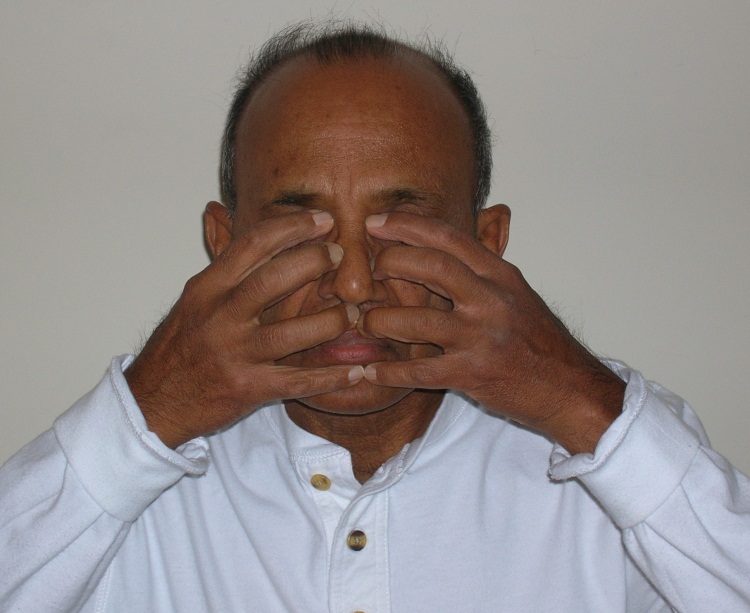
The word ‘bhramari’ (भ्रामरी) refers to the humming sound made by a ‘bhramara’ (a bumble bee in Sanskrit). The Bhramari Pranayama consists in making a deep, soft humming bee-like sound while exhaling.
Because Bhramari Pranayama has a very calming effect on the nerves and the mind, it is usually practiced as a prelude to meditation. As a part of the pranayama routine, it should be practiced at the end of other pranayama practices, usually after the alternate nostril breathing (naadi shuddhi), prior to getting ready for meditation.
Bhramari Pranayama is also practiced as a part of the yoga tradition called Nada Yoga (yoga of sound). As the name implies, Nada Yoga uses the element of sound, both external and internal, to reach higher levels of consciousness. In the subtle stage of Nada Yoga, one listens to internal sounds allowing the perceived sound to arise spontaneously. The Bhramari Pranayama is used as a preliminary stage of the practice of Nada Yoga.
Shanmukhi mudra
Bhramari Pranayama is practiced while applying the Shanmukhi Mudra (also known as Yoni Mudra). The word ‘shanmukhi’ (शन्मुखी) is composed of two Sanskrit words – ‘shat’ (six) and ‘mukhi’ (mouths or gates). So the full name means the ‘six-gated mudra’. The six gates refer to the two eyes, two ears, nose and the mouth. The purpose of the Shanmukhi Mudra is to symbolically shut the mind from the five senses so the mind can maintain an inward focus in the state of pratyahara (sense withdrawal) and get ready for meditation.
To shut the senses, the thumbs are used to plug the ears, the index fingers are placed on the eyelids, the middle fingers on the two nostrils, the ring fingers above the upper lip and the little fingers under the lower lip. There is no effort to press tightly against these organs but a light pressure is applied with the thumbs and fingers.
Step-by-step
- Sit in any comfortable, cross-legged meditation posture with the spine upright, arms and shoulders relaxed.
- Apply the Shanmukhi Mudra as explained above. Apply light pressure with the thumbs and the fingers against the various sense organs.
- Fix your mental focus at the third eye (Ajna Chakra), the spot between the eyebrows.
- Take a deep inhalation
- While exhaling, make a soft, humming sound. Try to keep the breathing deep and gentle so as to maximize the duration of exhalation without straining the breathing in any way.
- Repeat the cycle of inhalation followed by the humming exhalation ten times.
- At the end of the routine, you may continue with your own silent meditation.
Benefits
- Bhramari causes the whole brain to vibrate. Vibration of the cerebral cortex sends impulses to the hypothalamus which has the capacity to control the pituitary gland- the master of all glands. The hypothalamus also sends impulses to the sympathetic and parasympathetic nervous systems. This helps tune the whole neuro-endocrinal system to function in a harmonious and synchronized way.
- It calms the nervous system and brings in a mental state of calm and peace which is helpful in meditation.
- It helps in conditions of mental tension, high blood pressure, anxiety and heart-related problems.
- By constant practice of Bhramari, the yogi’s mind is absorbed in bliss (Hatha Yoga Pradipika -2.68)
- Here is an excerpt from an article that I came across recently. This article talks about the benefits of Bhramari for pregnant women based on research findings on several participants. The same benefits are applicable to all who practice this pranayama technique.
"… bhramari done for a few minutes daily can alleviate anxiety and tension. Vibration of the brain sends impulses to the reticular formation which eliminates anxiety and improves the mood, behavior and personality, so that the expectant mother may take care of her health and nutrition, leading to proper growth and development of the fetus. During labor, elimination of anxiety makes the mother co-operative and less apprehensive, thus facilitating easy delivery. " You can read the full article here.
Contraindications
There are no contraindications for this practice. Anyone who can breathe can practice Bhramari for great benefits.
[…] for peace, concentration and deep breathing – are the Anulom vilom and the Bhramari. The ‘Bhramari‘ (this link is to a yoga site I quite like) particularly has become an essential part of my […]
Hi Sir,
I stumbled upon this page of yours while researching about the various effects people experience while practicing Bhramari Pranayama with Shanmukhi Mudra.
I’ve only recently started practicing Bhramari Pranayama with Shanmukhi Mudra but if I get the placement of the fingers on the nostrils right, with the correct pressure applied, and then during exhalation, hum a little bit intensely (not great intensity, just greater than softly humming), then very shortly, I start getting that funny feeling in the stomach like you get on a roller coaster ride. It feels like a bit of a swirling action on the inside.
Now, I read in one of the comments above that Brahmari + Shanmukhi has the potential to lower blood pressure and it can cause dizziness. In my case, it seems different to being dizzy in that there is no discomfort. In fact, I enjoy it. Plus, as far as I know, I haven’t had any blood pressure related issues (I’m 35).
I was wondering if that’s a common feeling when practicing Brahmari Pranayama with Shanmukhi Mudra or does this have the potential to elicit different feelings and experiences in different individuals?
Thanks.
Hello Samir, the feeling in the stomach that you have described is not common. But, then, as you rightly mentioned, reaction from any of the practices is very individual. Is there a reason why you are trying to hum with more intensity?
Hi Sir,
Appreciate the prompt response. It’s to get that feeling I describe that I hum ever so slightly intensely. Like I mentioned, it comes across as a good feeling, like as if with the Shanmukhi Mudra blocking all external stimuli, the reverberations from the humming cause the internal organs to vibrate as well. I wonder if that roller coaster feeling on the inside could be a consequence of the resonant frequency of the body or the organs being matched by the harmonics of the humming sound? I’ve read that the funny roller coaster feeling in the stomach is from the organs experiencing free fall during a descent in the rides, at which time, I would expect the organs to not be touching the skeletal frame. From what I read, at the body’s resonant frequency, there is maximum displacement between the organs and the skeletal structure which may not be a good thing since it apparently places strain on the body tissues.
However, some other sources on sound healing talk about being able to cure diseased organs by means of injecting/directing sounds toward the affected organs, at their resonant frequencies in order to get them to vibrate once again at their respective natural frequencies.
To me, these two points seem contradictory. So, I’m not sure whether what I’m experiencing is actually healthy or detrimental.
Even though I haven’t had any such experience myself, I tend to agree with your assessment about the body resonating with the natural humming frequency. My suggestion would be to continue to enjoy the experience!
Hi Sir,
Will do, thanks!
Sir i have deafness in one ear….. can i get cured by it….. my age is 21yrs and i have this problem since my childhood
Hello Vinit, I have seen no research report that suggests that chronic deafness can be cured through the practice of bhramari. All I can say is that you keep doing this practice as it will bring many other benefits that are normally associated with the practice.
Dear Sir
I have got sudden high frequency sensorineural hearing loss in my left ear alongwith tinnitus. Shall bhramari prayanam help in recovering my hearing and removing tinnitus? If yes, for how much time should i practice this and usually in how much time should i expect getting improvement.
Sorry about your situation with hearing. I have not seen any recorded evidence that the practice of Bhramari can actually cure your situation. I suggest you continue the practice on a regular basis, about 5-10 minutes per session, and enjoy whatever benefits the practice gives you. Ideally you should practice all components of a yoga practice – asana, pranayama and meditation to derive full benefits.
Please suggest what are the benefits of Bhramari Pranayam with Khechari Mudra. Thanx a lot Dr.
Hello Richi,
for understanding the practice and benefits of Khechari Mudra, you should read the Hatha Yoga Pradipika. Personally, I don’t practice bhramari along with khechari mudra. Since khechari is supposed to have many benefits, I would assume that you will get combined benefits of bhramari with khechari. Try it out.
Hi, I am 70 year old man suffering from Parkinson decease for1 year. I am doing buburmahari for 2 decades. How to cure this decease?
Hello chudamani, sorry to learn of your disease. I don’t have any experience in treating your disease through yoga. However, the practice of yoga including asana, pranayama and meditation is helpful in improving an overall sense of well-being.
Hi, is it very harmful to do Bhramari before Anulom Vilom? I know someone who follows that routine and I read on some website that one should maintain this precaution but I wasn’t sure because that routine seems to work for them.
Also, thanks for the valuable blog.
You should trust web-based information only if it is from a reliable source. In my practice I don’t follow any such precaution as mentioned by you.
Hello sir,
. sir can I do pranayam in a dark room?
I got my M.R.M. done two years ago. now ear infectin is fully under control by doing Bharamari 5 times daily
Dev, that is good to know that you got your ear infection under control with the help of bhramari.
Thank you sir for your detailed reply.
So, if I understood clearly, you have been doing kapalbhatti since last 15-16 years after having your surgery for hernia? Am i right?
In that case I got my answer. I have been doing Kapalbahtti for last 8 months and will keep doing it for rest of my life.
That’s right, Kartik. I have been practicing it regularly for over 15 years with no negative effect that I can identify.
Hello Sir,
I do kapalbhatti for 30 minutes at the rate of 50 strokes per minute. very comfortable and gives me a lot of energy.
But on internet there are many articles saying kapalbhatti can cause hernia in the long run in future.
What is your view on this. How long have you been doing kapalbhatti?
Did you face any issues?
Do you know anyone who did kapalbhatti for 5-6 years and developed hernia.
Hello Kartik,
Rather than relying on random articles on the internet, I would rather rely on something that’s mentioned in an authentic yoga text by some well-known author. Having said that I must mention that I myself had surgery for hernia in 1999. It is hard for me to believe that it was caused by kapalabhati because I just started practicing it regularly less than a year earlier. In fact, I started having symptoms of hernia around the same time that I learned kapalabhati. Since the surgery I have been practicing KB regularly for about 10-15 minutes daily, at roughly 100 breaths per minute. I find the practice of KB truly energizing and cleansing. I have had nothing but the most positive results as a result of this practice. Of course, in addition to KB, I also have a full yoga practice including asana, other pranayamas and meditation. So, if you can find something from an authentic source, please do share with me. Thanks.
Is there any yoga for this type of problem….
Hello sir….sir my problem is I am not able to speak loudly…..so I don’t have any problem in speaking but the thing is my voice is very low…how can I improve my voice, so that I can speak loudly…
I meant one litre of water followed by green tea, immediately. Then nothing for the next 2 hours before pranayama.
Hi Kartik,
Yes, it should be fine if you give a two hour gap. Just curious, why do you drink a liter of water and why two hours before yoga?
Hello Sir,
Can I drink one litre of water and a cup of green tea, 2 hours before doing pranayama. My pranayama session is about one and half hour long.
Hello sir,
Sir I have undergone 2 times ear surgery for ear infection,doctors have removed my both the bones of my ears…now I am able to hear about 70% of all types sounds…but I am not able to hear when somebody speaks very softly, lightly…to improve my hearing I have been practicing pranayama,dhyana for 15 minutes each…in order to cure my mild deafness problems what I have to do now….and my question is whether I’m able to cure by deafness problem…?? Please sir answer my question…
Hi Srinidhi,
Sorry to hear about your hearing problem. Unfortunately I have no experience dealing with hearing issues through pranayama. Please keep practicing and hope for the best.
dear sir,could i cure blood pressure by pranayam without taking medicine.
Dear sir , i am Deepa 27yrs old and have high frequency hearing loss and doctor has advised me to go for hearing aid .. is ther any asana which can cure my hearing loss as it is nerve related ? Thank you
Hi Samhitha, I am sorry to learn of your HF hearing loss. Unfortunately, I am not familiar with any specific yoga practices that may be helpful in your situation. Practice of yoga will in general be helpful in many ways. So it is a good idea to establish a regular yoga practice to derive multiple benefits.
Sir,
I have too much high pitch voice,my age is 19 but my voice sound like a child’s voice…Can I get benefit from any of yoga asanas?
Dear Soumitra,
There is no assurance that the practice of yoga will help your situation. However, practicing yoga can provide multiple benefits. So try out variety of asana, pranayama and meditation practices.
Sir,
I workout in gym for 1 hour and after taking 10 minute rest , I do pranayama for 1 hour. Is this OK or should I do pranayam first and then gym?
Vivek Sharma
Vivek, depending upon what you practice as a part of pranayama, my suggestion would be to practice the more intense ones – kapalabhati, bhastrika, agni sara etc, prior to your gym routine. After resting for 10 minutes following the gym workout, you may want to do the more relaxing techniques like deep ujjayi breathing, bhramari and anuloma viloma.
Thank u sir.
sir,by which pranayam i can increase my hearing power?
Hello Subhankar,
The purpose of yoga practice is to calm the mind. In order to do that you need to practice asana, pranayama and meditation on a regular basis. Once you establish a regular practice, then you start working on individual issues like hearing problems etc.
Can Brahmari Pranayama be done with open eyes and with Mohanji’s Conscious Walking in a quiet park.
I find Conscious Walking recommended by Mohanji in the World Yoga Day on 21.06.15 in U.K very beneficial.I was reading articles confirming that it has helped some Parkinson’s Disease patient to get cured.
I will appreciate your expert opinion.
Dr,M.Sreetharan
Dear Sreetharan,
I am not familiar with the conscious walking that you are talking about. In the practice that I do, the bhramari is done in a sitting position with the eyes closed. You can always experiment with the new technique and see how you feel.
Sir,ear plug have any negative effect on ear?
Not to the best of my knowledge.
Sir,It have any effect on ear?
Sir,can I use ear plug during meditation to avoid noise?
sure, Subhankar.
sir, i am having tinnitus in left ear..will this help curing it
Hello Nikki,
I haven’t seen any research report which claims that tinnitus can be cured with bhramari. All I can say is that practices of yoga including asana, pranayama and meditation can only bring positive results in your life.
Sir,is it better to pranayam along with yoga and meditation in a closed room on evenging?
Dear Subash
Even though I was lucky to learn Yoga from Swami Sachchthananda
during the long school holidays of my first 3 years of secondary school I am doing Yoga now after retirement,almost daily by the inspiration given by Yoga Teachers at Local Nuffield Health and Fitness Centre.I was diagnosed to have high blood pressure 3 years ago.By attending regular Yoga the dose of my medication was brought to one third.My Consultant wants to know: Which Yoga Asanas he should recommend to bring Blood Pressure down.PLEASE HELP.
Hi Sreetharan, I think more than asana it is the pranayama practices that are likely to help with high BP. In particular all pranayamas involving deep patterns of breathing should help. You may want to avoid forceful kapalabhati and bhastrika. Among the asanas you may want to avoid any inversions like the sarvangasana and shirshasana.
Sir,could u tell about the precautions and restrictions of yoga,meditation and pranayam.
keep reading my blog for answers.
Sir,I have started pranayam and meditation.but iam doing these myself without guidance or expert guidance.so whether I get know iam doing correctly or not?
Subhankar, it is best to get training from a qualified instructor initially. Then you can continue on your own. Otherwise, you run the risk of doing it the wrong way and harming yourself.
Sir,2years ago I was studying plus two,during that time I suddenly got nervous for exam.my brain got blocked.since day iam always feeling blocked with clogged ears.so I can’t study.plz tell me what is this problem and how to cure?
Hi Subhankar, this seems more like a medical issue for which you may have to depend upon traditional medicine. From a yoga perspective, you may keep practicing basic asana and pranayama practices which may help.
Thank u sir
Sir,how can I do meditation with yoga combinely?which one is to be done first?
Hi Subhankar, sure, you can do meditation along with your asana practice. In fact, the recommended sequence is asana, pranayama and meditation.
Sir,I am suffering from hearing loss in both ears from last 1 year. I am suffering from cough too from last 2 years and tried many doctors but nothing worked.Is my hearing problem due to several times of coughing.will brahmri pranayama help me cure my hearing loss? Suggest me as soon as possible because day by day my hearing capacity Is becoming low.
Hi Siddhesh,
I have not seen any reports which state that bhramari can cure hearing loss. I suggest you establish a regular yoga practice including asana, pranayama and meditation. It will provide multiple benefits, including developing a strong mind which will help you deal better with your health condition.
Sir,
Plz suggest me which type of meditation is effective and which one is recommended for students?
Sir,
I am a student,iam confused to do what type of meditation?I know there are many types of meditation like mindfulness meditation,transcendal meditation.plz suggest me what type meditation to do?
Hello Subhankar, Try a couple of these practices and see which seems to give you the best results. Then stay with the practice.
Sir,
I am suffering from hearing loss in both years due to severe slaps by some body.
I meant empty stomach
Thanks Once again Sir,
They say pranayama should be done on empty. Is it fine to drink water 45 minutes before pranayama?
Or should i drink water once pranayama is done.
yes, Vivek, it is OK to drink water 45 minutes before pranayama. The main guideline is that you should give a gap of about 3 hours between a meal and yoga practice. Small amount of water 3-45 minutes before yoga is OK. After the practice also give about fifteen minutes before drinking something or about a half hour before eating something.
Sir thanks for answering all my queries so far.
One more question. Can i drink water immediately after pranayama or should I wait for 10-15 minutes or longer?
Also, I take food after half an hour after pranayama. Is that right or should i wait longer?
Vivek, I suggest you wait about 10 minutes to drink water after pranayama. Waiting for a half hour for food is just fine.
My pranayama schedule is as fellowing.
1) Bhastrika – 10 minutes
2) Kapalbhatti – 30 minutes
3) Anulom Villom – 30 minutes
4) Bhramari -20 minutes
5) Udgeet -10 minutes.
I am absolutely comfortable and feel revitalized after this 1.5 hour pranayama. Should I continue with this? Can i do pranayam in evening also for 20-30 minutes? I just love doing pranayama. I feel incomplete without pranayama.
Hello Vivek,
It is wonderful that you are able to spend time on pranayama practice and are enjoying the benefits. Since you are feeling comfortable with the practice, there is no reason to change anything. Of course, it is OK to do it in the evening as well. All the best.
Sir can I do brahmari pranayam for 20 minutes if i am comfortable?
Certainly, Vivek, you can go bhramari for 20 minutes. As you rightly said, you should stay comfortable throughout the practice.
Sir,
I have severe headache. When I bent down I feel the heaviness. I am hypo thyroidism and High BP. My BP and thyroid is normal with medicine. But since 15 days I am suffering with headache. Doctors could not help me. Please tell me which yoga and pranayama will help me. Please advise me.
Hello Sharada,
I recommend establishing an ongoing yoga practice that includes asanas, pranayama and meditation. While you have headaches, avoid deep forward bending poses. Also, in Pranayama, focus more on practices that involve deep breathing, e.g., anuloma-viloma, ujjayi pranayama, bhramari etc. A regular meditation practice will go a long way in bringing long-term positive benefits.
Helo MR, subash, i had been suffering from severe depression which was out of social phobia for a long time, i have stopped depression medication(Depran10, i practice, anulom viloam/kapalbhati/brahmri pranaym, but i am not getting relief. Sir. Please suggest any yogic natural remedy.
Well Shankar, to bring about good results, the practice of yoga must include all the components – asana, pranayama and meditation. Good, light, healthy diet and a positive lifestyle will also help.
Hello sir,
I love to do bramhari pranayam for more than 21 times.. I’m comfortable to do for 40 times at a stretch… is it ok that I do that much? any contradictions happen?
with regards,
kalyan sravanam
Hi Kalyan,
I haven’t read anything about an upper limit for the practice of bhramari. If it doesn’t cause any discomfort or any kind of problem and if you are comfortable with the practice, I think you can go ahead.
Thank u so very much Mr.subhash for all ur suggestions.I ll definitely work out on it and LL be back wid further queries.
Hi again Subhash,I have started pranayam few days ago.m doing anulam vilom with bhramari and after dat doing meditation,all in 30minutes.is it enough???
Hello Subhankar,
To make the yoga practice more complete, you may want to add some asana practice as well.
What types of asana should be done with pranayam?
Hi Sanjay,
I am not sure I understand your question. Can you rephrase it, maybe?
Iam always doing anulom vilom and bhramari pranayam simultaneously after dat doing meditation wid 25 minutes.is it perfect??? Suggest me.
Can I get sharp memory or brainy mind by bhramari pranayam??
Hello Subhankar,
To get sharp memory and a brainy mind, you need to get rid of a lot of mental debris that clutters the mind and keeps it dull. To effectively do this cleansing, you need to practice the full yoga routine – asana, pranayama and meditation on a daily basis over a long period of time. Once you have a regular ongoing routine, then you can add additional time for bhramari and see how it helps.
Dear Mr. Subhash,
I’be been suffering g from OCD for the past few years. I believe in meditation and yoga rather than meditation and counselling. I personally feel yoga and meditation are much moreover powerful for mind related ailments like OCD. Please help me in telling me about the asanas/pranayama that I should be following to get relief from OCD and finding some mental peace.
Hello Sai,
I really have no experience of helping people with OCD. So, I am not in a position to provide any specific guidance for your situation. However, practicing yoga which includes the practices of asana, pranayama and meditation are supposed to help in all health conditions. I believe pranayama and meditation may be the most beneficial for you.
Dear Mr Subhash,
I started doing daily Pranayama 50 days ago. I use a DVD by Dr Vasant Lad. My nervousness is gone. However, something strange is happening with my blood pressure. My blood pressure is perfect in the morning and in the early afternoon (115/60). At around 7PM it goes up sometimes to 155/85 or higher. I do not take ANY medicines except vitamins and herbal products. My diet consists mainly of vegetables, fruits, beans, nuts and seeds. I don’t drink or smoke.
Any comment about this issue will be greatly appreciated.
Hi Bertha, that’s a huge shift in BP from morning to evening. No, I have no idea as to why this might be happening or what you can try. My suggestion would be to keep your pranayama and meditation practice going on a regular basis. Try to avoid more intense forms of pranayama – like kapalabhati and bhastrika but stay with the more gentler ones involving deep, ujjayi breathing.
Sir,
During pranayama, every body suggest for padmasna (cross legs pose). But when I do padmasana, i feel discomfit immediately. Shall i o padmasan or sukhasana in meditation. Kindly help me? what are better foo for doing pranamaya.
Hello Gopinath,
One of the key guidelines for the practice of yoga is to avoid any pose/movement that does not feel comfortable. So, if Padmasana is not comfortable, sit in Sukhasana. If you have trouble sitting on the floor, sit in a chair or on top of a cushion. While doing pranayama or meditation, if there is pain in any part of the body, you will NOT be able to do your practice.
Sir,
I am spondlolysis (back pain). Doctor advised me not to do any asana of front bending movements. Also asked to reduce weight. Please inform what are the better option or me. Also suggest to how to reduce weight.
Hello KC,
Yes, you should avoid deep forward bending and backward bending poses. You can modify them to go only half way, if it feels comfortable. To reduce weight I suggest the following:
Eliminate fried food from your diet – no pakora, samosa, puri etc
Eliminate any sweets that you buy from outside. If you like to eat sweets, prepare them yourself with controlled quantity of fat and sugar.
Maintain a daily practice of yoga that includes asana, pranayama and meditation.
Dear Mr. Subash,
I am very much pleased on your interest in spreading yoga. If you permit, I will post some yoga articles based on the SUNDERAKANDA of Ramayana. Waiting for your reply.
Dear Das,
Thank you for your offer to write articles on my blog. Please send me a draft via email so that I can make an assessment if the article is appropriate for the blog’s main theme. Thanks.
Hello Mr. Subash jee,
kindly enlighten me in point wise, as I am having some quires in Bhramari.
1) In single Bhramari, how-many cycles one can do? (i.e If wants to do Bharmai in single sitting, as much as 5-6 cycle or more)
2) How-many Bhramris ( one sitting of Bhramri) in a day?
3) In bhrami one has o take long/deep inhale exhale or short/fast inhale/exhale.
4) During deep/long Bhrmari, i am facing some light at the eyebrows /eyes – what its significance?
5) You have mentioned that the Bhramri to be done after end of the yoga-asans. But I am doing only bhramri (not any asanas). Will it create problems?
Hello Trinath,
1. In one sitting, I would suggest spending 5-6 minutes, whatever the number happens to be.
2. Two sessions should be adequate – one in the morning, one in the evening
3. Full inhalation, followed by long exhalation, making the humming sound during exhalation
4. I don’t know about the light in the eyebrows
5. Why not include the practice of asana in your routine? It will help you in multiple ways. Doing bhramari alone will not cause any problems.
hello sir ,i m ocd patient is there any yoga series that help me to get out from ocd , is bramhari help me in this or not
Hello Saurav,
to get relief from OCD, practicing only one of the yoga techniques may not provide the desired result. You will need to develop a full yoga routine which includes the practice of asana, pranayama and meditation. The best is to find a local yoga teacher who can guide you through the practice. Try to make it a life-long habit. Gradually you will start feeling the benefits with regard to your situation with OCD. All the best.
Thank you Mr. Subash for your immediate response. Definitely I will do as per your guidance.
Regarding night, I am taking 2 apples & 2 cucumber with half liter warm milk. Wit this I am getting good sleep & free motion also not feeling any weakness till now (for last 7 days i have started). My question is whether it will create any weakness in longer run?
Trinath,
Let you body be the best guide for you. Since you are feeling fine now and no weakness, just continue with the routine. Your body will tell you if it is not feeling right and then you can modify the diet plan.
Sir, I am doing the basic yogasana and pranayama. I getting good sleep & mentally fit, with the age of 45 Years. Shall I do bharamri daily to control blood pressure?
Regarding diet, I am taking heavy break-fast around 8.30 am an lunch at 2 p.m. evening some snacks. I have seen some one article of Sivavanda wherein they suggested for taking fruit & milk at night. for last 3 days, i am taking fruits and warm milk at night. My wife tells me that if I am not taken food at night, I will be weak in coming days. What shall I do? taking food is better of fruits with warm milk. Kindly guide me sir.
Dear Trinath,
It is nice to see that you are practicing yoga on a regular basis and deriving good benefits from it. Practicing bhramari will definitely bring many benefits. Whether of not it will help you with your blood pressure may depend upon many other factors – lifestyle, stress levels, diet and sleep habits etc. My suggestion would be to keep practicing it for whatever benefits you can derive.
Try out your diet plan of fruit and milk at night for some time. If you start feeling week, you can always revert back to the old diet. Wishing you all the best.
Dear Subash
I am a retired Doctor.Are you also a Doctor?Are you practising?If so in what field of Medicine?If not may I know what your field is and under whom you were trained and in which country.
Kind regards
Dr.M.Sreetharan.U.K.
Dear Sreetharan,
No, I am not a doctor. you can view my profile on my webpage here http://yogawithsubhash.com/about-2/
Regards,
Subhash
how to do bhramari pranayam
Dear Manjeet, please read the step-by-step instructions given in this article. Thanks.
Hello Sir,
I do Bhramari (bumble bee) 7 repetitions only once a day.
It is so calming that I would need to do it 2 or 3 times a day. Would that be too much? Or could it be dangerous?
Thank you!
Hi Bertha,
It is great to see that you are enjoying the practice of bhramari and finding it useful. sure, feel free to practice it more than once a day. As far as I know, this practice has no negative effects associated with it.
Thank you for your kind reply. My holistic chiropractor has told me that I am in a constant fight or flight mode and has sent me lots of homework to do. I decided to add Pranayama in order to get better relaxation and be able to balance my sympathetic and parasympathetic systems that have gone berserk.
Stresses have been piling one on top of the other and, despite my daily practice of Qigong, my subconscious mind gets stressed at just anything.
I have found Bhramari extremely helpful and fast acting, and if you have any other tips for me, I will add any other yoga/pranayama exercise that you recommend me for stress/anxiety.
Once again, thank you so much for your kindness.
Dear Bertha,
I am glad to see that you find Bhramari helpful in your situation. I would suggest adding some more pranayama practices to your routine – Ujjayi pranayama, rapid breathing, and alternate nostril breathing (naadi shuddhi). You can search for instructions on this blog. The other practice I recommend is the candle gazing technique called trataka. Please keep us posted here with your progress.
Thank you so much for your kind advice. I will try to add those to my practice. Fortunately, I have a DVD by Dr Vasant Lad which includes Ujjayi. However the alternate nostril breathing I have on this particular DVD is Anuloma Viloma, not the one that you are recommending. I will manage and learn it somehow. Blessings.
PLEASE SUGGEST TECHNIQUE FOR HEARING LOSS. MY BROTHERS ONE EAR IS TOTALLY BLOCK. HE CAN NOT HEAR FROM RIGHT EAR
Dear Bharat, I am really sorry but I am not familiar with any yoga techniques that can help with hearing loss. If any of the other readers know of any please do share here. Thanks.
i am suffering from nerve deafness and tinnitus what can i do pls help me through pranayama sir
Dear Praveen, unfortunately I don’t have any experience with either of the conditions that you have mentioned. I am sorry but I am not able to suggest a possible yoga therapy for them. All the best.
Hello Praveen, unfortunately, I am not familiar with any yoga practices that can help with the conditions that you mentioning. Maybe someone else who is reading this blog can provide some information.
Tinnitus problem I am suffering pl help
Dear Priyanca, unfortunately, I don’t have any direct experience with helping people with Tinnitus. One exercise you may want to try is to do “twirling” around yourself. Spreading the arms horizontally, looking constantly at the middle finger of the right hand, go around yourself clockwise a few times. This is supposed to help with inner ear balance and also with general hearing.
The other suggestion I have is to use the ringing sound as your mantra for meditation. That means, use the ringing sound that you hear in your ears as the object of meditation. Let us know how it goes.
Sir, i m suffering from chronic tinnitus condition ,,,can u help me throughout
Dear Meenu, unfortunately, I don’t have any direct experience with helping people with Tinnutus. One exercise you may want to try is to do “twirling” around yourself. Spreading the arms horizontally, looking constantly at the middle finger of the right hand, go around yourself clockwise a few times. This is supposed to help with inner ear balance and also with general hearing. The other suggestion I have to use the ringing sound as your mantra for meditation. That means, use the ringing sound that you hear in your ears as the object of meditation. Let us know how it goes.
Hi Subash,
I been doing pranayama since 15days. I perform bhastrika (3 Minute), Kapalabhati (15 Minutes), Bahya (3 Minutes), Anulom-Vilon (15 Minutes) Bhramari (5 Minutes). I’ve started feeling uncomfortable intense vibration in my forehead. Some I feel like my head will blast due this vibration & there is severe headache. It becomes hard for me handle this vibrations. What shall I do now? So now I’ve decreased pranayama to 30 Minutes,and doing it once in 3 days. Is there any specific diet required? Please guide what shall I do now? Shall I stop doing meditaion and pranayama? Do you have any contact number, if so please mail me on karansony@gmail.com.
Respected sir
I take ocd treatment
Alopathic medicine
How i will came out without medicine
Dear Dhaval,
All I can tell you is that the practice of yoga can only help but will not cause harm, if done under the guidance of a qualified teacher. I don’t think anyone can give you an assurance as to whether you will be rid of medication for your OCD condition.
HI,
I’ve been doing pranayama since 15days. I perform bhastrika (3 Minute), Kapalabhati (15 Minutes), Bahya (3 Minutes), Anulom-Vilon (15 Minutes) Bhramari (5 Minutes). I’ve started feeling uncomfortable intense vibration in my forehead. Some I feel like my head will blast due this vibration & there is severe headache. It becomes hard for me handle this vibrations. What shall I do now? So now I’ve decreased pranayama to 30 Minutes,and doing it once in 3 days. Is there any specific diet required? Please guide what shall I do now? Shall I stop doing meditaion and pranayama?
Dear Rahul,
Was this routine recommended by a teacher or did you pick up on your own from some books or videos? If you started pranayama only 15 days ago, then the routine that you are doing is too much for your body which has not been properly primed for the practice. If you learned the practice from a teacher you need to go back to the teacher and get his guidance. My suggestion would be to cut down kapalabhati to about 5 minutes. Depending upon the type of bhastrika, you may want to eliminate bhastrika from your practice until you start feeling normal again. There are no specific guidelines for diet as the needs vary from person to person. In general a sattvid diet is recommended. Also please continue with your meditation practice as well.
Wishing you all the best,
Subhash
Hello Sir,
I have the problem of sunken eyes for last 3 years , Doctors couldn’t diagonised the reason behind it, I’m doing yoga religiously for the last 10 years and maintain a very healthy lifestyle but this problem isn’t going away, I’m very upset about it, I also sweat profusely, Please suggest the right mudra for it. Thankyou.
Dear Vikrant,
If the doctors haven’t found anything and you are practicing yoga regularly, maybe the sunken eyes are your natural state. Please accept it gracefully and live on happily with your life.
Sir, need help. Am struggling to find cure for inner ear imbalance. I get imbalance or disorientation whenever there is a change in the plane surface or at heights in aeroplanes seeing ripples in water in traffic like situations. Kindly advise. Thanks and regards
Dear Kumar,
One of the movements that I have read about which might help with inner ear balance is twirling around yourself in the clockwise direction. Come to a standing position with the arms spread out horizontally, in line with the shoulders. Start twirling around clockwise at a comfortable pace while constantly looking at the middle finger of your right hand. Gradually build up to about 20 rotations. When you come to a stop, keep gazing at the right hand until the room and the surroundings also come to a stop. Try it out and share your experience here.
Hi Subhash, i would like to know if it is strict that Bhramari is to be done on the exhalation only, as i had read on the internet that it’s also done on the exhalation or is this just another variation?
Indeed, James, bhramari can be done both during inhalation as well as exhalation. The Hatha Yoga Pradipika in shloka 2.68 states that the male humming bee sound should be made during inhalation and the female bee sound during exhalation.
Dear subhash sir. My mind continuously keeps on wandering and as a result i am unable to concentrate on any work. I am unable to sleep at night also. What should i do
Dear Shivam,
Wandering around is the basic nature of the mind. One thing you may want to try is to take a brief snapshot of what is going on in the mind at a given time. Then pause for a moment and try to find out why that particular thought/feeling/emotion etc. might have appeared in the mind. For example, if you get angry, pause for a moment and see what might have caused the anger. You don’t even need to go any further – just finding the cause can help slow the mind down.
Just by doing this simple exercise, your mind will begin to slow down and you will be able to stay focused on your task for longer periods of time. Hope this helps.
i can learn yoga. U can also try it
Hi Subhash, i had read somewhere that i must practice anulom vilom with Bhramari in order to gain the beneftis of Bhramari, or else its useless, is this true though?
Hello James,
Can you please provide the reference where you read it? I haven’t seen anything like it mentioned in any of the texts that I have read. I must add that I have read most of the major yoga texts. The best is to practice it both ways and see which gives most benefits.
Respected Sir,
When I doing Bhramri Pranayam with chanting Ommm, I feel very small movement or very small vibration on the centre of forehead (between eyebrows). It’s like a touch of very small vibration. Is that natural?
Dear Bapi, as long as the vibration or the movement is not painful or uncomfortable, you need not be concerned about it. Just enjoy that feeling along with the sound vibration of the bhramari or the OM chant.
I have pitutary tumore recurancy. Can I do bhramri despite having tumore. It will be great help to me ,if you reply. Thanks a lot.
Dear Pragna,
Sorry for not getting back to you earlier. I just missed seeing your comment. Yes, bhramari practice, in my opinion, is quite OK to do despite the tumor. It should be helpful in calming the nerves as well as the mind.
I have the problem of Ringing sound and humming sound in my left ear and hearing loss in both the ears.Please advise me how Pranayama can help to get rid of this problem.Also please advise me how to do Pranayama for this application.
Thanks a lot.
Dear Krishnan, I am sorry to hear of your problem with ringing in the left ear. Unfortunately, I don’t have any experience in helping students who are in a similar situation. In general, though, various pranayama techniques might help you at least in calming the mind and allowing you to cope better with the situation. Some of the common pranayama practices that you may want to try are kapalabhati, bhramari and Naadi Shuddhi (Anuloma Viloma). You will find these techniques helpful in bringing an overall sense of well-being. Wishing you all the best.
Any other advice for this problem sir? Tinnitus is ruining my job, relationships and life
Dear Vinay,
I am so sorry to learn of your head injury and the resulting tinnitus condition. Unfortunately, I haven’t had to deal with a similar situation in the past. My suggestion would be to read up on the concepts of Nada Yoga (yoga of sound). There you might be able to find ways to use the sounds that you hear as the object of your meditation and meditate on those sounds. This may help you tune in with the sounds and make them a part of your being and not treating them as annoying interference. Hope this will provide some relief. Wishing you all the best.
Dear sir,
I got hit on the top of my head by a wall a month ago and suffered mild concussion. All the symptoms have subsided except fluctuating tinnitus since a month. Can tinnitus go away on its own? How does bhamari pranayam help in tinnitus ?
Hello James,
Since sitting in Anjali Mudra is not a part of the routine that I practice or teach, I am not in a position to guide you as to how long you should stay in that position. I use the Anjali Mudra only when I am chanting a mantra. It is also the first of the twelve position in the Sun Salutations routine. If you can provide me some background as to where you got this practice from, I may be able to understand the significance and then provide some guidance.
In terms of the position of the palms, I believe the palms are slightly open in the middle. The significance being that we are ready to receive divine blessings by keeping the palms slightly open.
Or are there variations?
Reply add: what i mean by seperated is that they are slightly open at the middle of the hand whilst the fingers and rest of hand are touching.
As i have seen somewhere on the itnernet that they are slightly seperated.
I would also like to know if anjali mudra is done with the palms pressed completely together or are the palms seperated to some degree?
The practice im doing is where i sit in half lotus position doing anjali mudra, im just unsure as to how long it should last for.
Hi James,
To help me provide a good answer, can you please describe in detail the practice that you are doing? Thanks.
How long should i generally practice anjali mudra for? is 10 minutes three times per day enough?
Hi again Subhash, i wanted to know that if i’m practicing anjali mudra, do i need to keep a perfectly straight spine or will it have no effect if i do not?
Hi James, for most yoga activities, especially pranayama and meditation, it is highly recommended that you maintain a straight and vertical spine. The only guideline is that despite the effort to keep the spine straight, no strain should be felt. So, you should make any adjustment to the position that will keep it straight and yet comfortable. hope this helps.
Subhash
Hi subhash my. Frank name is I want to know if there is any video to practice the bhramari to calm my mind and nerves because I have.been in turmoil for long time but because I practice meditation I notice some changes even I am confuse at times Wich meditation to practice and if I do practice the bhramari whit is the sequence breathing you inhale thrum your mouth or nose and how you make humming bee sound thrum your nose or mouth any would bee appreciate thank you
Hello Frank,
Unfortunately, I don’t have a video for the Bhramari practice on my website. I am sure if you did a google search, you will find some useful demos. The humming sound is just like you would make when you are humming the tune of a song you like. So, the breathing is still through the nose (both inhalation and exhalation). The humming sound is generated by constricting the passage of the breath at the back of the upper palate. Hope this helps.
Hi there, i wanted to ask if practicing brahmari can grant enlightenment?
Hi James,
Enlightenment can be attained only when the effect of all “samskaras” (past latent impressions) have been nullified. According to Patanjali that can be achieved when the mind is made free of all fluctuations. Can Bhramari take you there? I don’t know!
Hello James, is there a reason why you would like to avoid the shanmukhi mudra? The shanmukhi mudra a symbolic representation of the state of pratyahara and is supposed to aid in getting to that state. However, if you don’t use the mudra and just focus on the sound of bhramari, I think you should still be able to get into the state of pratyahara. My feeling is that it might be a little harder to stay focused on the sound without the mudra.
Hi Subhash, i just wanted to ask that if i do not include shanmukhi mudra but practice Bhramari enough can i gain the state of Pratyahara?
Hi Subhash, i just wanted to ask that if i do not include shanmukhi mudra but practice Bhramari enough can i gain prayahara?
Respected Shri Subhashji,
Your Bhramari (Humming Bee) Pranayama method is simply superb. Your illustration is just like a live demonstration to any one keen to practice pranayam
Thanks a ton.
Regards,
N.K. Ramani
Dear Ramani, I am truly grateful to you for taking the time to go over many of the posts on different aspects of yoga and providing your most valuable feedback. It is gratifying to know that you find the material useful.
Hi sir, a few days I started my readings on Eastern view and the like, and just to know that I recognize that many things happen to me comes from the imbalance of the chakras. And somehow I was starting with the solar plexus. The sir. considered a good way to start?
And how can it be proven the existence of these chakras as organ supraphysical?
Dear Antonio, I am glad that you have started your readings of the Eastern philosophy. The concept of chakras has been in existence for thousands of years. I don’t know of a scientific way to prove the existence or otherwise of the chakras. In general I prefer to go with the wisdom of the ancient yogis who came up with these concepts after being in prolonged state of deep meditation. I think the best is to follow their guidelines and enjoy the experience.
Hi James,
As you can guess, everyone’s experience from a given practice could be different depending upon individual in-born tendencies. as I suggested earlier, it is best to practice bhramari in conjunction with other pranayama practices. However, by itself, it can help calm the mind and the nerves.
Some results atleast?
I read on the internet that without practicing pranayama prior to practicing Bhramari that Bhramari would bring no desired benefit, but you suggest that Bhramari will bring results even without doing pranayama first?
Bhramari is supposed to calm the nerves and the mind. I practice 5 rounds of Bhramari just prior to my meditation as it seems to settle the mind to some extent.
I have been practicing Brhamari by itself for a short time now and wanted to know what it’s benefits would be. Thank you.
What results can be gained from doing Bhramari alone?
I actually had one last question, can i practice Bhramari and still get benefit without doing other pranayama first? Or is other pranayama required?
I normally recommend that we should include these few basic pranayama techniques in our daily practice – kapalabhati, bhramari, deep three-part yogic breathing, and alternate nostril breathing (aka naadi shuddhi or anuloma-viloma). Each of these techniques offers a different set of benefits. So a combination will provide optimum results.
Hello again, thank you for your reply. It takes me about 15 mintues to do 100 repetitions and i am not training under a teacher.
Hi James,
How long does it take you to do the 100 repetitions? Are you doing this under the guidance of a teacher? I am a little surprised at the number 100 as it seems a little excessive. I am not able to give you a specific recommendation as I don’t know why or how you started doing these many repetitions.
As for keeping the tongue at the roof of the mouth, that is an optional technique (called Khechari Mudra) and can be safely done along with the Bhramari practice.
I also wanted to know that when practicing Bhramari do i need to place my tongue at the roof of my mouth or is it not required?
Hi again, i practice 100 repetitions of bhramari every morning and wanted to know if this is good or should i reduce the number?
Hi, i was just wondering if Bhramari can be done without the mudra or is the mudra required? Because i see some yogi’s teaching people Bhramari without the mudra. Thanks.
Certainly, Bhramari can be done without the mudra. However, the Shanmukhi mudra is recommended because it brings about the state of Pratyahara wherein the mind can be disengaged from the five senses thus enhancing the experience of the humming sound.
Sir,
I can not sit in normal yoga posture (PALTHI)for more than 2-3 mins after that it starts hurting and even in that posture my back does not remain eract. Please suggest any other assan or sitting posture.
Yours Faithfully
Sukant Singh
Dear Sukant,
Inability to sit in cross-legged posture (sukhasana) is caused by tightness in hips and knees. This tightness can be reduced by a regular practice of yoga asanas. Some of the asanas that may be specifically helpful are: butterfly (Titali pose) both half and full version, trikonasana, parivritta trikonasana, getting into a chair pose with the back resting against the wall, reclining twist etc. I wish you all the best.
Hello sir,
im having mild varicocele since 10 yrs which is asymptomatic and cause pain only when i do exercise and yoga,i want to do yoga as it keeps me fit but it causes me pain of varicocele.I read ur article about bhramri which is very helpful,can u pls tel me some yog asana which wil not cause me pain of varicocele
Dear Varun,
varicocele is an uncommon condition and I do not have any personal experience helping anyone with this condition. So, unfortunately, I am not in a position to recommend asanas that you may or may not practice. If you can provide the list of asanas you already practice, I will be glad to do some research before making any recommendation one way or the other. Wishing you all the best,
Dear Subhash Sir,
After I practice Bhramari and close my ears for few seconds, I fell cool water flowing like feeling in my ears. Is this a good effect or am I not doing it right.
Thanks
Rita
Dear Rita, everyone can have a slightly different experience as a result of different pranayama practices. As long as you don’t feel uncomfortable, you should just welcome and enjoy every experience.
I feel more effective when i close the ears and nostrils after breathing in and release them while breathing out.
Is this a good practice.
Dear Sita Ram, for the Bhramari pranayama to be effective, the nose and ears should be lightly closed during exhalation while you are making the humming sound. The idea is to shut out all external influences and focus entirely on the experience of the sound vibration of the humming breath. I hope this helps.
Dear Sir,
My husband has been asked to practice Brahmari 54 times by his voice culture specialist. I have been doing yoga with a yoga instructor regularly and we do not do it more than 5. After 2 days of Brahmari he says that his throat feels hollow and is painful. Is it ok to continue like this?. Thanks for the post.
Dear Anusha, I apologize for not getting back to you earlier. In yoga practice, one of the guidelines that we follow is to never stretch yourself beyond your own comfort zone. We may need to challenge ourselves sometimes but not to the point where the practice is hurtful. My recommendation will be to practice only as many rounds of bhramari as feels comfortable. Once you practice on a regular basis, your capacity will keep on increasing. try to make steady progress. Please let me know how it is going now.
Dear Sir,
Thanks for your immediate response. As u said my husband practices like 15-20 brahmaris per day as he feels comfortable and is not exhausted doing them. And, he is doing aerobics to increase his lung power. It is doing great wonders to his voice. Once again thanks for your help.
Dear Anusha, I am so glad to see that your husband has been able to do 15-20 bhramaris per day and that he is feeling more comfortable with it. I wish him continued success with his voice capability.
dear sir,
in my personal practise i have also concluded that while doing brahmri the arm should be at right angles with the torso. this stretches and relaxes the back muscles i.e the trapezius and latissimus dorsi.
also, removing muscle spasms and knots, t facilitates the ascension of kundalini. please keep the good work going and put up more spiritual posts.
thanks and best regds,
Thanks for this additional insight, Vinay. Such information can be really helpful for the visitors of the site. The only potential problem with keeping the arm at right angle is that after a few rounds the arm may begin to tire out.
Bhramari does lower blood pressure so people with pre-existing low blood pressure can get dizzy with the practice. Otherwise very fine practice!
Thanks, Wendy, for your comment. You are making an interesting observation and I would like to know if you have some scientific studies in this connection.
Sir,
I have been advised by my doctor to include Bhramari as one of the daily exercises to help with my border-line high blood pressure.
I find the exercise very calming and resonant. But I have a question on the practice.
When I place my ring fingers under the nostrils, the sense of vibration is much more stronger, powerful and resonant while exhaling with ‘hmmmmm’ sound. This feels very good. But I find inhaling more difficult because the fingers partially block the nostrils. What should I do?
Thank you very much for your response and advice.
Dear Mallik, thanks for your note. As there a few different ways to practice bhramari, could you please describe the technique that you are following for your practice? Thanks.
Thanks a lot Subhash Sir. Its so kind of you to reply so quickly and advise me on one more technique. I would start doing it from today and let you know the results after few days.
Hello Sir,
In my right ear, sometimes I feel like air is blowing in and out. And this makes me feel very uncomfortable. I checked with one of the YOGA doctors, they aksed me to practice Shanmukhi Mudra. I am practicing it right now, but the blowing of air still persists. Could you please let me know would practicing this mudra, reduces my problem or else are there any other asanas i can practice to completely get rid of this.
Dear Deepa,
Thanks a lot for visiting my blog. As for your symptoms, I really have no experience with your specific situation. As such it is hard for me to tell whether shanmukhi mudra would help or not. The practice of various pranayama techniques is supposed to be helpful with many of the ailments related to ear, nose and throat area. The only other technique that I can think of is the twirling around yourself which is supposed to help with the inner ear balance and with the health of the ears in general. In this technique, you start in the standing position with the arms stretched out in line with the shoulders. Turn your neck to look over the right shoulder and fix your gaze at the middle finger of the right hand. Then start twirling around yourself at a comfortable, steady pace. You may start with about ten rounds and slowly over a period of a few days, build up to 21 circles. When you come to a stop, continue to look at the middle finger of the right hand until the room and the surroundings also come to a stop. Let me know if this proves of any help. Thanks.
Hello Sir , i want to get rid of my eye glasses and make my number close to zero ,is it possible by doing Bhramari pranayam 10 to 15 times daily or work out with 10 to 15 mins daily . i have come around some people saying they have solved the eye problem upto 100% satisfaction / with zero number clearity … Sir can you plz guide with this problem ?
Thank you,
Chirag bhosale.
Hello Chirag,
Thank you for visiting my blog. I know that Bhraamari can help with eyesight but I haven’t seen any research which says that you can completely cure your vision. I have written a blog post (http://yogawithsubhash.com/2010/01/22/yoga-for-eye-care-a-7-step-program/ ) on eye care and I strongly suggest that you go through that post and follow the guidelines given there. I have seen some reports which claim that by following similar guidelines as what I have given, people have benefitted a lot as regards their vision. I wish you all the best. I hope to hear back from you with your progress.
— Subhash
Thank you for your quick response-
Can Brahmari pranayam be done lying down on your back before going into savasana?
Dear Veena,
Thanks a lot for visiting my website. Even though I have not practiced Bhramari in a lying down position, I don’t see why it can’t be done that way. Bhramari is suppoed to calm the mind down and it should be OK to do it just before going into Shavasana.