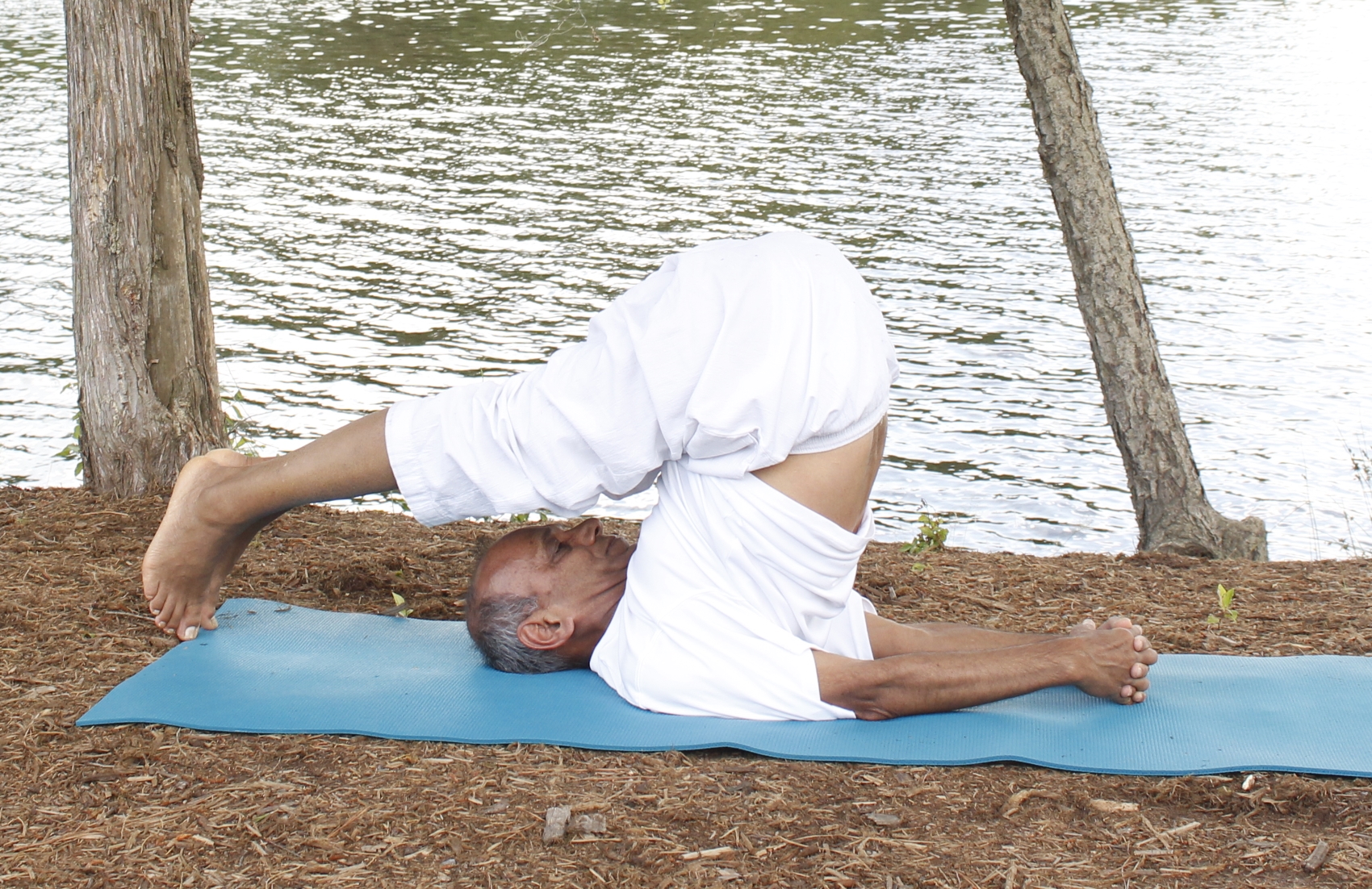
The word "hala" in Sanskrit means a ‘plow’ (also spelt ‘plough’), a basic implement in the old days used to till the soil. In its final position, it resembles a wooden plough which is pulled by one or two oxen or horses in the field. The mention of the name ‘plough’ brings back memories from my own childhood days while I was growing up in the villages of Punjab where this was a common site in the fields.
Halasana is one of the best poses for stretching every part of the spine, especially the upper part of the spine. It is commonly practiced as a concluding variation of the ‘sarvangasana’ (shoulder stand). However, it can be practiced as a stand-alone pose for all the benefits that it provides (see under ‘benefits’ below).
Basic Halasana
Step-by-step
- Lie down flat on your back with the arms alongside the body, palms facing down.
- Keep the legs straight and together throughout the practice of the basic pose.
- Relax the whole body and mentally prepare for the pose.
- Slowly raise the legs to a vertical position; try to use abdominal muscles more than the arms while raising the legs up.
- At this point you may use the support of the hands behind the back to raise the legs further.
- Exhale and continue to raise the legs over the head, bending at the waist, lifting the back and buttocks.
- Make an effort to bring the feet all the way down until the toes touch the floor directly behind the head.
- If you cannot touch the floor with your toes, hold them as close to the floor as possible and continue to exert a gentle effort to lower them, without causing any strain.
- Keep the feet together. If the lower back is supported by the hands try returning the arms flat to the floor with the palms facing down. If you are unable to comfortably place the arms on the floor continue to support the lower back with the hands.
- If the arms are on the floor, try to join the palms, interlock the fingers and gently pull the hands away from the body.
- Keep the knees straight. Maintain your natural breathing pattern and hold the posture for about 30 seconds. At no point you should be straining yourself to hold the pose.
- With practice, over a period of time, you may begin to increase the holding time for the pose.
- To come out of the pose, begin by first lowering the back to the floor, one vertebra at a time.
- When the tailbone touches the floor, begin to release the legs down. Try to keep the legs straight and use the abdominal muscles to support the downward movement of the legs.
- Finally rest in shavasana for a few breaths.
Variations of Halasana
Variation 1
This variation is simply an extension of the shoulder stand (sarvangasana). From the final position of the shoulder stand, begin to lower the legs overhead and follow the same guidelines as mentioned above for the practice of halasana.
Variation 2
In the final position of Halasana, stretch the hands toward the feet and try to grasp the toes. Pulling the heels away from you, try to bring the toes closer to the head. This stretches the lower back.
Variation 3
In the final position of Halasana, pull the heels in toward you and push the toes away from you.
This variation stretches both the back and the neck very effectively.
Variation 4
From the final position of Halasana, bend the knees and try to bring the knees close to the floor and close to the ears. If comfortable, you may like to wraps the arms around your legs. This variation of halasana is also called the ‘karnapidasana’ (‘squeezing the ears’ pose).
Variation 5
In this variation, hold the big toes with your hands. Now begin to spread the feet apart as far as they comfortably go. Hold the position for about 30 seconds and then bring the feet back together.
Variation 6 (Dynamic Halasana)
In this variation, we combine two poses – the forward bending pose (pashchimottanasana) and the halasana – in a dynamic movement synchronized with proper breathing.
- Start in the forward bending pose. In the seated position, stretch the legs straight out in front. While exhaling, begin to bend forward, going as far as comfortable.
- While inhaling, roll your back down to the floor, and dynamically bring the legs overhead into the halasana position.
- While exhaling, once again roll back into the forward bending pose.
- Continue in this manner for 6-8 breaths, keeping the movement completely synchronized with the breathing, as described here.
Counter Pose
Any of the backward bending postures can be used as the counter pose for halasana. The most commonly practiced are matsyasana (fish pose) or the ushtrasana (camel pose). These asanas release the compression of the neck and throat by stretching the neck in the opposite direction.
Benefits
- All of the muscles and ligaments in the calves and thighs are stretched resulting in greater flexibility of the legs. People suffering from leg cramps will find great relief from the halasana.
- Since the abdominal area is contracted, blood compressed out of this area releases toxins. When the contraction is released the area is flooded with richly oxygenated blood. The contraction also helps to relieve gas and stimulates a sluggish digestive system. All the abdominal organs – liver, pancreas, gall bladder etc are massaged.
- Similar effects take place as the neck and chest area is compressed benefiting the throat, thyroid, parathyroid and the lungs.
- Upper and lower back pain or discomfort is relieved due to the forward stretching of the spine. Halasana makes the whole spine supple, stretches and loosens the back muscles and the vertebrae and tones the nerves.
- Many of the benefits of the sarvangasana (shoulder stand) also apply to the halasana, with the added benefits detailed above. In fact, as mentioned above, Halasana is commonly practiced as a final variation of the shoulder stand.
Contraindications
- Those suffering from hernia, slipped disc, sciatica, high blood pressure (not controlled with medication) or any serious back problem should avoid Halasana.
- While in the final pose, make sure not to move the head around. Any movement of the head can result in neck injury.
Question for you: Do you practice halasana as a variation of the shoulder stand or as a stand-alone pose? Do you practice any variations other than those mentioned in this post? Please provide your comments below.
Greetings from Ravi Suryadevara.
It is heartening to note people share their practices in this forum enriching each other with useful knowledge.
I do practice Halasana( plough posture ) as a stand alone posture – maintained for 60 breaths immediately followed by sarvangasana(shoulder stand ) which is maintained for 60 breaths and then followed by Viparita Karani ( inverted posture) and maintained for 60 breaths and then immediately followed by Matyasan( Fish posture ) which is maintained for 60 breaths.
I have been doing this sequence for about 3 decades.
I consider whole of this sequence as one integrated set of inverted postures which easily flow one posture to next posture.
Thank you Subhash ji for your contribution to the practice of yoga.
Regards,
Suryadevara Ravi
Thanks again, Ravi, for sharing your experience. Very helpful to our readers.
Thank you for the prompt reply. I will rest and practice the suggested asanas.
Hello – I’m 35, have slight compression between C5 and C6 in my cervical spine. And have mild lumbar scoliosis since adolescence. I’ve been practicing Hatha yoga six days a week for a couple of months now. Two days back I was able to do Halasana for the first time. My lower neck and upper back is hurting since – are there any counter poses I can do or is resting better. Thank you.
Hello Chandrima, I recommend mostly rest along with a few gentle stretches like the Pawana Muktasana, marjarasana (cat and cow) and the reclining twist. Get back to your main yoga routine only when you feel that the back has healed.
I am regularly doing yoga (though with some breaks) including halasana. While Master check up in scanning i was diagnized linguinal hernia. I did not have much trouble but little pain near right side groin. can I do halasana or stop with sarvangasana?
Hello Rajaram, I looked up a few websites and a couple of books to see what they say about your situation. What I found is that sarvangasana and halasana are both helpful for inguinal hernia. However, they should be avoided for hiatal hernia. Of course, your body is your best guide. Try it out a few times. If it seems to aggravate the situation, stop – otherwise keep doing it.
Actually i didnot have any problem but occassional pain in lower abdomen /groin . In scanning it is diagnised as Lingual hernia.
I am a regular yoga practioner doing halasana also. Need I stop that.
Hey, I am a beginner though I was able to do the pose but it caused neck pain. Kindly advise the other poses which will help me to reach halasan (plow) pose without any difficulty.
Hello Pratibha, just don’t force yourself to bring the feet down to the floor behind you. Slowly, with practice, you’ll develop strength and flexibility of your neck and shoulders.
I also suffer from High BP. I have it under control by medication. Would practising Halasana have any adverse effect on my high BP
Hello Joseph, as long as BP is under control with medication, you can keep practicing Halasana. If BP fluctuates a lot, you may want to skip both Sarvangasana and Halasana.
Dear Sir,
I have read in a few articles that practising Halasana helps to control (not cure) Sugar Levels. Is this true?
Hi Joseph, any posture that creates a massage of the internal organs can help with sugar levels. Halasana is also one such pose. So, yes, it could be helpful for sugar levels. In addition, all poses that involve twisting the body are also helpful.
I regularly practise Halasana in the morning and I have got good result out of this asana.
Thanks, Samir, for sharing your experience with Halasana. It is so nice to see that you are enjoying the benefits of your practice. Can you say a few words about the type of benefits you are getting? Please let us know what other aspects of yoga you practice.
[…] & Images source: @, […]
Hi! I’m a complete beginner in yoga and in addition 13 weeks pregnant. We did the plow pose yesterday for the first time and although I had told to the instructor of my pregnancy she didn’t advise me not to do this pose. I’m quite worried for my baby now. How bad it is?
Dear Kris, first of all congratulations on your pregnancy. Doing the plow pose just once will most likely do no harm at all. I would suggest that you join a prenatal yoga class rather than a regular class. In the regular class you may end of doing some of the movements which are not recommended during pregnancy. The poses that you should avoid include: all poses where you are on your abdomen – cobra, locust, bow etc; any of the inversions including shoulder stand, headstand, plow etc; deep forward bending poses with the legs together. Among the breathing practices, avoid Kapalabhati, bhastrika, any breath retentions. This is just a sampling and your prenatal teacher will be able to guide you more. I hope this helps. Please do not hesitate to contact me if you have more questions.
plow pose is the ONLY thing (poses, therapy practices etc) that Ive found that will alleviate my neck and back pains (for myself and my body- I know everyone is different!)I do it several times a day or my back will go out. Now I am pregnant and Im quit worried about not being able to do this pose anymore. Are there any other poses you could recommend that may have some of the same benefits? Im hoping at least it will be ok to continue this pose during my first trimester..thanks, I apologize for anxious rambling : )
Hello Winter, congratulations on your pregnancy. As you rightly mentioned, generally plow pose is not a recommended pose during pregnancy. However, if you have a strong practice of yoga prior to getting pregnant then you should be able to continue with plow through first trimester, Again, in general, since the body is going through major changes during early pregnancy, any yoga practice should be done very carefully and preferably under the guidance of a qualified teacher.
As for some of the other poses that are beneficial for the back during pregnancy are – cat and cow, bridge, downward facing dog, reclining leg stretches, child pose with the legs and knees apart, gentle seated and standing twists etc.
I hope it helps. Wishing you all the best.
i have controlled high blood pressure can i practice halasana?
Certainly, when the BP is controlled, you can practice both Halasana and Sarvangasana.
Wow, Suhash, I had no idea the plow was also beneficial for the thyroid and parathyroid glands. Thank you for writing in depth about it.
Is it okay to do this pose while pregnant?
Hi Bridget,
As I mentioned here, Halasana is usually practiced as an extension of the shoulder stand. In the “Integral Yoga” tradition that I teach, shoulder stand or any inversion is generally not recommended during pregnancy, unless one has a strong personal practice prior to getting pregnant. Halasana exerts much more pressure on the abdomen due to its compression. So, I would suggest that if one has an existing, on-going yoga practice, halasana may be practiced until the end of the second trimester, certainly not beyond. In general, it is probably safer to avoid it during pregnancy. Let me know what you think.